Friday, January 24, 2014

Native American Folktales for Spring 2014


 Just to brush up on our geography, I thought that I'd post a map of the Pacific Northwest, the part of our country where the Coyote Tales we read came from.  (The map is from Sheppard/Wood Distributors, a commercial warehouse and distribution company from Boise.)

"Coyote and Bull" and "Coyote and the Mallard Ducks" came from the Nez Perce, so I thought I would begin with a little information about this people, but while we are posting maps, I will post a map of the territory held by the Nez Perce in the 19th century.  This map is from the Chief Washakie Foundation's web site.

Adam Kittleson's article from Minnesota State University at Mankato's E-museum is a good place to begin.

https://web.archive.org/web/20100228202717/http://www.mnsu.edu/emuseum/cultural/northamerica/nez_perce.html

This history is from the Nez Perce tribal government's official website:

https://web.archive.org/web/20100122032113/http://www.nezperce.org/history/nimiipu.htm

https://web.archive.org/web/20100213233815/http://www.nezperce.org/Official/historyfaq.htm

For more detailed information, see this article by Deward E. Walker, Jr. and Peter N. Jones:

http://content.lib.washington.edu/aipnw/walker.html

The Nez Perce were also among the many peoples that the Lewis and Clark Expedition met on their way to the Pacific Ocean.

http://www.pbs.org/lewisandclark/native/nez.html

The Nez Perce were also known for their Appaloosa horses:

http://www.nezperce.com/npedu13a.html

If you don't know what an Appaloosa horse looks like, here is a picture below. The picture is a public domain photograph from Wikimedia Commons.

Chief Joseph (1840-1904) was also one of the most famous Nez Perce.  For his story, see this link:  http://www.pbs.org/weta/thewest/people/a_c/chiefjoseph.htm

This biography is also interesting:

http://www.windriverhistory.org/exhibits/chiefjoseph/chiefjoseph01.htm

The picture of Chief Joseph below is from Wikimedia Commons.  It was taken in 1877.


Here Jeff Head writes about his travels along the Nez Perce trail.  The pictures are beautiful!

http://www.jeffhead.com/magruder/index.htm

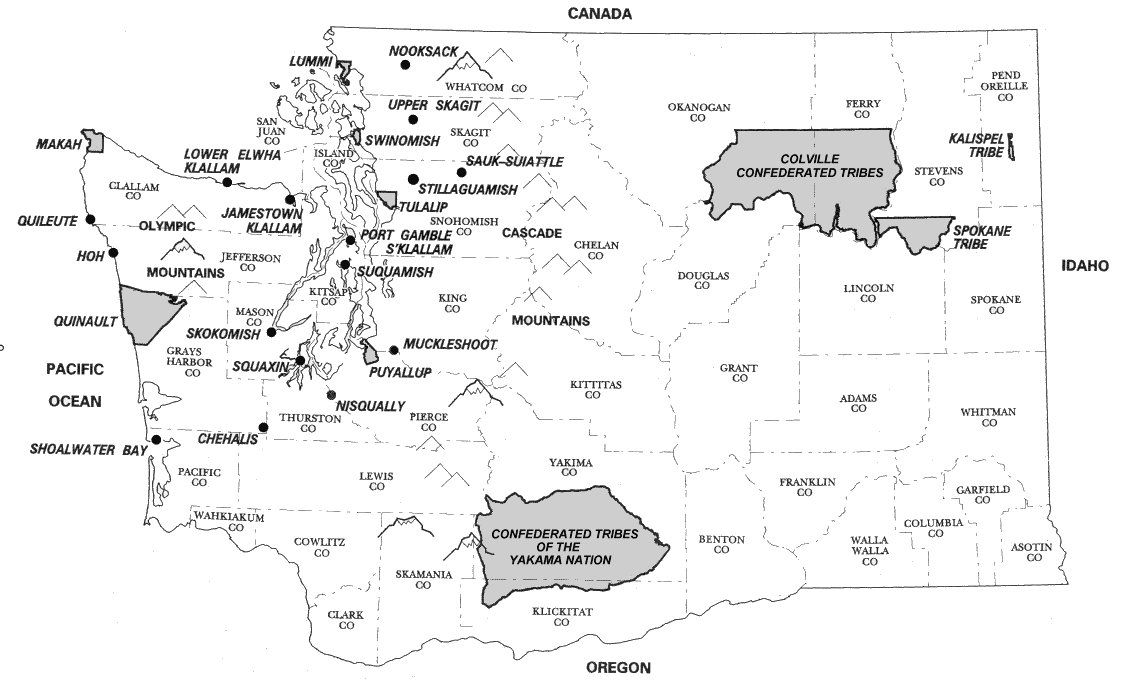
On to the Wishram, the people who gave us "Coyote and Eagle in the Land of the Dead."  They once lived along the Columbia River, the border between Oregon and Washington.  At one point, they were relocated to the Yakama Reservation, about 100 miles north of this area.

As you may see from this free map from the Map Company, quite a few groups lived in this area.  The map below shows where the Wishram live now as part of the Yakama Confederation.


Here is a little more information about the Wishram:

http://www.nationalgeographic.com/lewisandclark/record_tribes_064_13_33.html

http://www.pbs.org/lewisandclark/native/wis.html

For more information about the Yakama Nation, see this site.  Scroll down past the ads for an interesting article.

http://www.ohwy.com/wa/y/yakamana.htm

Below is a Wikimedia Commons picture of Wishram petroglyphs at a site called Wishram Village.  It is now part of a national park near The Dalles, Oregon.


Scroll down for more information about Wishram Village or Nixluidix:

http://www.waymarking.com/waymarks/WMYPK


The picture below is from www.waymarking.com.


The story of She Who Watches is also from the Wishram:

http://www.lensjoy.com/gallery/20.htm


The photo below is by Chris Carvalho.


With the Shoshone and "Wolf Tricks the Coyote Trickster," we return to Idaho.  Finding a map for the Shoshone is particularly difficult since their one-time territory was so large.  The map below is from Boise State University's magazine Idaho Issues Online.  Here are a few pieces to put together, but I will provide only an overview and focus on the Shoshone within Idaho since the story about Wolf and Coyote is from the Lemhi-Shoshone.


For more information about the Shoshone, see these sites:

http://www.shoshoneindian.com/

http://www.nationalgeographic.com/lewisandclark/record_tribes_017_11_8.html


This site also includes audiofiles as well:
https://web.archive.org/web/20080515074417/http://www.wisdomoftheelders.org/program301.html


Lewis and Clark's guide Sacajawea was a member of the Shoshone although she had been kidnapped away from her tribe and sold into slavery.  The illustration below is from the Chief Washakie Foundation's website.

http://www.shoshoneindian.com/sacajawea_001.htm


Here is a web article on Chief Washakie, an Eastern Shoshone chief who lived into the 20th century.

http://www.windriverhistory.org/exhibits/washakie_2/index.htm

Below is a picture of Idaho's Snake River, along which the Shoshone lived.  This picture came from the University of Montana-Missoula's Regional Learning Project.


Leslie Marmon Silko (whose poems I read on Monday) is descended from the Laguna Pueblo in New Mexico.  As we learned from reading "Franz Boas' Visit," she also has white ancestry.  The map below is from Prof. S.J. Crouthamel's site for his course, Introduction to American Indian Studies at Palomar College.


The Pueblo is a much larger group, but I thought I'd begin with an overview.

https://web.archive.org/web/20090222025653/http://www.cabq.gov/aes/s3pueblo.html

Writing in 1932, James Paytiamo explains how the Laguna Pueblo came to be and were named.

http://southwestcrossroads.org/record.php?num=508


This history is more formal and less anecdotal:

http://southwestcrossroads.org/record.php?num=665


This profile essay on Leslie Marmon Silko also gives you a little background on the Laguna Pueblo.

https://facultystaff.richmond.edu/~rnelson/woman.html

Here is an extended interview with Ms. Marmon Silko:

http://www.altx.com/interviews/silko.html

The Laguna Pueblo are also known for their pottery:

http://www.clayhound.us/sites/laguna.htm


The picture below is also from www.clayhound.us .


I will finish up with information about the AnishinaabeGerald Vizenor's background.  This people lives in the upper Midwest, in Minnesota.  Specifically, Vizenor is a member of the Minnesota Chippewa Tribe, White Earth Reservation (see the map from Native Wiki further below).

 
For more information about the Minnesota Chippewa, see the site below:

https://web.archive.org/web/20090404051854/http://www.mnchippewatribe.org/a_brief_history.htm

This site has quite a bit of information about the White Earth Reservation:

http://www.kstrom.net/isk/maps/mn/whitearth.htm


With our current interest in biodiversity and local food, the wild rice has become more and more important:

 https://web.archive.org/web/20100113111156/http://www.savewildrice.org/

A branch of the Anishinaabe are based in Canada.  Anishinaabe-Canadian Norval Morisseau's work is depicted below.  I found this image at virtualmuseum.ca , an online collection of images from Canada's museums.


Wednesday, December 4, 2013

Study Guide for EN 190/190HM -- Key Terms

Some terms from the end of fiction may be on our final exam, but the bulk will be from poetry and perhaps film.

We'll start with fiction though.

style -- includes diction (word choice, connotation) and sentence structure

tone/voice -- focus on irony but also tragic ("The Story of an Hour")

epiphany -- type of ending that began with Joyce, very influential, psychological/spiritual insight

These terms will be important in our reading of Sherman Alexie's work:
plot vs. character
flashback
storyteller
reservation
internalized repression
life writing ("Superman and Me")


For film (Nosferatu), please note the following terms:
silent film -- note that there was usually live music to accompany the film
Rosa Rio was one of the many musicians who did this; however, she lived to be 108 and was able to perform up almost to the end:  http://www.youtube.com/watch?v=Um2whr-1VO0

shot
scene
mise-en-scene
camera angle
lighting
film as technology
copyright -- copies of Nosferatu were destroyed when the courts ruled that Murnau's film violated the copyright of Bram Stoker's Dracula
realism vs. fantasy
Expressionism
Romanticism
folklore
supernatural
Weimar Republic -- the German government between the world wars and before the rise of Hitler
The musical Cabaret is set as Hitler comes to power in Germany.


Most of our terms will be from poetry.

Note the differences between free verse and formal verse (rhyme and meter).

Free verse may have organic form (Denise Levertov).

Formal verse includes the sonnet but is not limited to it.  The sonnet is a fourteen line poem in iambic pentameter (ten syllables).  It follows specific rhyme schemes.  The Shakespearean sonnet follows this form: abab cdcd efef gg.  The Petrarchan sonnet (like Gwendolyn Brooks' "the rites for cousin vit") follows another format: abbaabba cdecde or cdcdcd or...there are quite a few variations. The sonnet is from Italy, and Italian is easier to rhyme.
Villanelles and ballads are other forms of rhymed poetry.  The sestina, pantoum, and bop are not rhymed.

Many of today's spoken word poetry rhymes and follows a certain meter.

See the link below for more information about the bop, a new form that we discussed in class:
http://www.poets.org/viewmedia.php/prmMID/5773

Note that the speaker and the poet may not be the same person even when the poet uses first person.  A poet may be writing a dramatic monologue, giving voice to a fictional or historical character.  Robert Browning's "My Last Duchess" exemplifies the dramatic monologue.  A poet might have a persona as Charles Bukowski suggests in "Bluebird":  http://poetry.rapgenius.com/Charles-bukowski-bluebird-lyrics#note-1183362

On the other hand, since the rise of confessional poetry in the 1960s, the boundaries between poet and speaker have broken down.  Sylvia Plath, Robert Lowell, and Anne Sexton are among the most well-known confessional poets.


Stanza is a "paragraph" of poetry, that is, a unit that makes up part of the whole.  Here is one stanza from Aafa M. Weaver's "Rambling":

In the yellow circle the night stops
like a boy shot running from a Ruger 9mm
carrying .44 magnum shells, a sista
crying in the glass booth to love's law,
to violence of backs bent over to the raw
libido of men, cracking, cracking, crack... 

Note that in most lines there is enjambment.  In other words, there is no end-stop or even semicolon, colon, or comma at the end of the line.  Instead, the line spills over.  Sometimes the break happens within a phrase.

In "Those Winter Sundays," note that in the beginning Hayden uses more enjambment than he does in his last stanza.  
http://www.poets.org/viewmedia.php/prmMID/19217

Image is important in poetry, and so are diction, denotation, and connotation.

Consider voice, tone, and sound as well.

More technical terms are simile and metaphor, onomatopoeia, alliteration, assonance, consonance, rhyme scheme, and repetition.  Types of rhyme are end-rhyme, internal rhyme, slant rhyme, single rhyme, and double rhyme.  Other technical terms are synecdoche and personification.

On Nov. 19, Dr. Michael Anthony Ingram came to speak to our class and perform his poems.  He brought up the concept of metaphorical scream.  I have just posted his PowerPoint at MyMC.

Next to Last Set of Questions for EN 190/190HM


Good afternoon :)

It looks like tomorrow will be a day mostly for review.  Danny and Aurora, are you still doing your presentations in class?  Also, I'm not sure if everyone has signed up!

Yesterday we had a number of wonderful presentations: Juan's presentation on Dante and the Divine Comedy; Christian, Ambrose, and Samir's presentation on baseball and race; Amber's presentation on Ophelia syndrome; and Orlando's presentation comparing Nosferatu and JoJo's Bizarre Adventure.  Thank you!

Here are a few questions to help you continue with your review.

-- Choose one of the presentations we've seen or you've looked at on MyMC.  How has it helped you understand literature more fully?

-- Choose your presentation.  How is working on it helping you understand literature more fully?

-- Should we read more older work in EN 190 like Shakespeare or Dante or other authors?  Why?  Why not?

-- Choose one of the readings listed below at our study guide:  http://en202.blogspot.com/2013/11/study-guide-for-final-en-190190hm-fall.html  What does this reading add to EN 190?  Why? Could it be taken out?  Why?

-- Choose one of the readings listed on our study guide.  How does it exemplify its genre (short story, film, or poem)?  How is it different from other examples of the genre?

-- Go to MyMC or our textbook.  Then choose one of the readings listed on our study guide.  How does this reading choose one of the key terms for the second half of EN 190/190HM?  How does your knowledge of this term help you understand the reading more fully?

-- Choose two poems.  Why are they worth comparing?  How does comparing them help you understand them more fully?  Which poems are not worth comparing?  Why?

-- Choose a theme such as parent/child relationships, youth, gender, America, nature, etc..  Choose two readings, preferably from the second half of the semester, that depict the theme in a DIFFERENT way.  How does this comparison help you understand them more fully?  How does it help you with the theme?

-- Choose one reading.  How many different themes apply to it?  Why?

-- How is your research helping you understand the readings that you are comparing and contrasting?

-- What is most difficult about your research?  Why?

Feel free to send me your rough draft of the last paper.  Also, be sure to write up your evaluation of the class while the link is still available!

See you at our last class.  :)

Tuesday, November 26, 2013

Fourteenth Set of Questions for EN 190/190 HM


Good evening :)

Today we began our series of in-class presentations with Lukas, Kate, and El Hadj's Prezi on world literacy and Amavi and Sophia's PowerPoint on Sherman Alexie.  Amavi and Sophia even showed us some of Alexie's poems as well as an intriguing scene from his movie Smoke Signals.  There will be more to come--and the presentations will be on the final exam!  (This includes web-only presentations.)

We also reviewed Academic Search Complete, finding a number of sources on poets, categories of poetry, and themes.  We were able to find very literary articles, book reviews, and articles from other disciplines, which nonetheless pertain to theme.

Here are the two poems by Sherman Alexie:

Let's include the videos we listened to today:
(Erykah Badu) http://www.youtube.com/watch?v=mEXu6UmRPZc

(Common) http://www.youtube.com/watch?v=LssFolrpiD4

Here are a few more questions for your journal:

-- Use Academic Search Complete to find an article for your paper.  Which article did you find?  Why did you choose it?

-- Look up Sherman Alexie on Academic Search Complete.  Which articles did you find?  Choose one.  Why did you choose it?

-- Use the terminology we've learned this semester to discuss one of Alexie's poems.  How does that help you understand it better?  

--  Which other poem (or short story) would you compare "Good Hair" to?  Why?  Which other poem (or short story) would you compare "Dangerous Astronomy" to?  Why?

-- Compare/contrast Alexie's poems.  Bring in Alexie's short stories or "Defending Walt Whitman," the poem we haven't discussed in class:
http://www.bpj.org/poems/alexie_whitman.html  Which poem or short story do you like best?  Why?

-- Compare "Fans, Friends, Artists" or "Letter to the Law" to a poem you've read this semester.  Why did you choose the other poem that you did?  How does this comparison help you understand the two poems (and poetry) more fully?

-- Here are links to two songs by Erykah Badu and Common.  Compare/contrast them to the artists' poems.

-- What surprised you the most about Lukas, Kate, and El Hadj's presentation on literacy?

-- How might literacy (or the lack of it) affect literature?

-- Which factors might affect literacy in a society?

-- Do you think that the US will maintain its high rate of literacy?

Have a great Thanksgiving & Black Friday, and take a little time to write up an evaluation for the class!

Thursday, November 21, 2013

Presentations in EN 190/190 HM -- Fall 2013


Here is our schedule so far.

Tuesday, Nov. 26

1.  Kate, Lukas, & El Hadj
2.  Amavi & Sophia

Tuesday, Dec. 3
1.  Juan
2.  Amber
3.  Ambrose, Samir, & Christian
4.  Orlando

Thursday, Dec. 5
1.  Aurora
2.  Danny


Web-only
1.  Mike
2.  Joselin
3.  Aymen
4.  Zdenka
5.  Cristina
6. Fred
7.  Segen
8.  Cassandra

If you don't see your name here, please let me know where you would like to present.

Thanks,

Dr. Szlyk

Thirteenth Set of Questions for EN 190/190 HM


 Good evening all :)

Today was our last day of new material as the presentations begin on Tuesday, Nov. 26 (our next class).  However, I will review database searches with you and perhaps even play some spoken word or slam poetry for you on Tuesday.

Let's start, though, with some links.  The first is the handout on templates, which I went over at the beginning of class.


Next is a link to the first part of our study guide:
http://en202.blogspot.com/2013/11/study-guide-for-final-en-190190hm-fall.html

Then here are links to sources that you may find helpful for the upcoming paper.  The first is Denise Levertov's essay on organic form, which I referred to today:

The others are articles that Dr. Ingram recommends:
Patrick Carmagian's "Untempered Tongues: Teaching Performance Poetry for Social Justice"
http://files.eric.ed.gov/fulltext/EJ832207.pdf

"I Just Want to Be Heard" by Pellegrino, Zenkov, and Calamito:

Finally, here is a link to Aafa M. Weaver's bop "Rambling":
http://www.poets.org/viewmedia.php/prmMID/22359

The Robert Johnson song is here:
http://www.youtube.com/watch?v=AUyKnEiv70Y

Evelyn N. Alfred's bop is here:
flashes: a bop for bix b.

he hungered for the notes
playing before he could see the keys
mother bird chewed them for him
while he regurgitated beauty
fingertips savoring the song
without knowing the recipe.

the hungry and the hanged, the damaged and the done
striving along this spinning rock, tumbling past the sun

without knowing the recipe
he learned how to taste the tune
adding brown sugar, nutmeg,
and horn lines
but couldn’t bake an unfamiliar harmony
cooling his heart,  sinking the middle
to what effect?
is a fallen cake ruined?

the hungry and the hanged, the damaged and the done
striving along this spinning rock, tumbling past the sun

is a fallen cake ruined?
forced to flash up the treble
singed in chicago winds.
south side speakeasies
intoxicated his ballads
he hungered for the notes.

the hungry and the hanged, the damaged and the done
striving along this spinning rock, tumbling past the sun

The song excerpt comes from “God Bless Our Dead Marines” by A Silver Mt. Zion

The Bix Biederbecke song that inspired Evelyn's bop is here:http://www.youtube.com/watch?v=UK2PW4di53I

Now, let's finish up with a few questions.

-- Try one of the templates at http://www.bgsu.edu/downloads/enrollment/file108404.pdf, using the theme that you'll be writing about or even one of the sources you are considering using.  What would you write after that?

-- Look for a bop poem online.  How does it compare to and contrast with "Rambling" or "flashes: a bop for bix b."?  Which poetic devices do you notice in the two poems?  What is the effect of the refrain?  do you recognize the song where the refrain is from?

-- Compare and contrast a bop poem with another of the poems we've read so far this semester.  Discuss each poem's use of poetic devices.

-- What might have led Aafa M. Weaver to create a new form of poetry?

-- Which poems are you going to compare and contrast?  Why?

-- Discuss free verse and form.  Which do you prefer?  Why?  How does form make poetry more poetic?  How does free verse make poetry more poetic?

-- Discuss the impact of line breaks, stanza breaks, enjambment, and end-stops in a poem.  This poem may be one we've discussed.  It may be one we've skipped over.

-- What comes to your mind when you think about poetry?  Why?  Why not?

Watch your inboxes for our schedule of presentations!

Dr. Szlyk

Twelfth Set of Questions for EN 190/190 HM


Good afternoon :)

I hope that everyone enjoyed Dr. Ingram's talk and performance today.  Here is a link to the DC Poetry Project Website.


Dr. Ingram (and his co-organizers) hold workshops and performances throughout the year.  The next half and half workshop is this Saturday, and then in December there are a number of service activities such as the NAMI/DC Christmas Party 

Thursday will be our last day of new material as we have many presentations and few days remaining to the semester.  Please read chapters 16 and 17 in our anthology.  The topics will be rhyme and meter and form and type.

In addition, here are some spoken word pieces for you:

This piece from British spoken word artist Suli Breeze is timely:
http://www.youtube.com/watch?v=D-eVF_G_p-Y

Have you watched Jefferson Bethke's controversial video:
http://www.youtube.com/watch?v=1IAhDGYlpqY

Erykah Badu performs "Friends Fans and Artists Must Meet":
http://www.youtube.com/watch?v=mEXu6UmRPZc

Here is Kinetic Affect's "Lost and Found":

I'll finish with a little slam poetry.

Here is Rachel McKibben's "Central Park, Mother's Day":

Regie Cabico performs "What Kind of Guys Are Attracted to Me":
http://www.youtube.com/watch?v=WlqQzKBfNFE

And here are your questions:

-- How did Dr. Ingram's performance shed light on poetry for you?

-- How do his poems use rhyme and meter?

-- If you were to compare one of his poems to someone else's poems that we have read or watched, which poem would you choose?  Why?  What would be the poems' "theme"?

-- How do his poems use form?

-- What does it mean to "metaphorically scream"?  Of the poems we've read or listened to, which metaphorically scream?  Why?  

-- Would you want to read and perform your poetry for your presentation?  Why?  Why not?

-- Would you want to read and perform someone else's poetry for your presentation?  Why?  Why not?

-- What does spoken word add to poetry?  How is it similar?  How is it different?

-- What is it like for you to listen to work by a celebrity like Ms. Badu or Common?  Is this work poetry?  (Here is a piece by Common:  http://www.youtube.com/watch?v=LssFolrpiD4 )  Why?  Why not?

-- What does slam poetry add to your understanding of poetry?  How is it similar?  How is it different?

-- What role does performance play in poetry?  Why?  Why not?

I'm looking forward to seeing and hearing what you have to say!