Monday, April 7, 2014

Questions After 4/4 Class


Above is a link to Katherine Pyle's illustration from the story of Mishosha.  This illustration dates from 1911 and is part of a children's book of stories from various cultures, including India.

Here is a link to the Popeye cartoon that we watched:  https://www.youtube.com/watch?v=FyVEaMz3EPg

For Monday, I would like you to read the following short stories:  Longstreet’s “The Dance” and Sedgwick’s “Cacoethes Scribendi.”  As I mentioned, Longstreet is a Southern writer.  Sedgwick is a feminist writer.

Here are a few questions for you and your journal.  BTW, the journal is a great way to catch up on your readings.

-- Rip Van Winkle is a mythic figure from American literature.  Why do you think that he has captured our imagination in a way that other fictional characters have not?

--  What are other mythic figures from American literature or history?

-- What does "Rip Van Winkle" tell you about the transition to the United States?  Why?

-- Here is an outline of the hero's journey.  http://orias.berkeley.edu/hero/journeystages.pdf
How do Rip Van Winkle and the older brother in "Mishosha"  follow this journey?  What do you make of the way that Rip Van Winkle parodies this journey?


-- Why is the story "Mishosha" named after the antagonist?

-- Here are some Ojibway/Chippewa myths.  Compare/contrast them to "Mishosha."

How may Mrs. Schoolcraft have adapted her story for non-Native audiences?

-- Compare "The Dance" and "Cacoethes Scribendi" to the other short stories you've read in 211 or elsewhere.

-- How does Longstreet depict the South in his story?

-- How does his story develop the theme of American identity?  or American literature?

-- How does Longstreet and Sedgwick depict relationships between men and women in their story?

-- How does Sedgwick depict writing in her story?

-- How does her story develop the theme of American identity?  or American literature?

-- What is it like for you to turn to fiction?

-- How does American literature seem to be developing in the early 1800s?

I am looking forward to seeing what you have to say!

Wednesday, April 2, 2014

Questions After 4/2 Class


Above is the statue of Phillis Wheatley in Boston.  It dates from 2003 and was sculpted by Meredith Bergmann.


Good evening :)

On Friday we are moving on to the short story with Washington Irving's "Rip Van Winkle" and Jane Schoolcraft's "Mishosha."  What is it like for you to move to this familiar genre--and to return to Native American writing?

Here are a few questions for you, which are based on today's reading & discussion as well as on Friday's reading.

-- Again, what is it like for you to return to poetry with Phillis Wheatley's work?

-- If you are familiar with African-American poets from the 1900s and 2000s, consider how Miss Wheatley may have influenced them.  Is it a good thing or a bad thing that she has influenced them?

-- Discuss Miss Wheatley's approach to poetry.  How did it appear to evolve over time?  Which themes did she favor?  Which devices did she try?

-- Compare Miss Wheatley's poetry to Mrs. Bradstreet's or Rev. Taylor's.

-- Compare Miss Wheatley's poetry to the work of these 18th c. British poets.  Some, like Alexander Pope's, are neoclassical.  Others are Pre-Romantic or Romantic.  The second poem is by Ann Yearsley, a servant-poet whose literary patron was Hannah More.

How do these other poems help you to understand Miss Wheatley's poetry?  Where does she fit in with these poets?

-- How does Miss Wheatley argue for her humanity in her poems?  Is it effective?  Is poetry in general an effective way of arguing for one's humanity?

-- What do her poems reveal about slavery in the colonies and/or Boston?

-- What do her poems reveal about religion in her era?

-- What do her poems reveal about the transition to the United States?

-- Again, what is it like for you to turn to fiction?

-- How are Irving and Mrs. Schoolcraft's stories similar to fiction you've read?  How are they different?

-- How do Irving and Mrs. Schoolcraft represent American identity and experience?  

-- Compare Mrs. Schoolcraft's story to the Native American myths you read at the beginning of the semester.

-- Are you familiar with the story of "Rip Van Winkle"?  Compare Irving's actual story to the versions you may be familiar with.

-- What do these stories reveal about the transition to the United States?

-- What do they add to American literature?

I am looking forward to seeing and hearing what you have to say!

Dr. Szlyk

Questions After 3/31 Class


Above is Miss Wheatley's portrait by Scipio Moorhead, the artist she addressed in her poetry.


Good evening :)

It was good to see everyone at the library.  It looks like we may have another theme to try: sympathy in literature.  When you think about it, you have quite a few themes--and works to choose from.

Wednesday we will not have a presentation.  Instead, we will return to poetry with Phillis Wheatley and John Dickinson.  Note that this is a change in reading and a return to regular chronology.

-- What did you learn from Ms. Pandya's presentation?

-- Try out a search term at JSTOR, Project MUSE, or Academic Search Complete.  What did you find at the database?

-- Look up one of our authors at Biography in Context.  What did you find?

-- What would you like to write about for the stand-alone essay?  Why?

-- What would you like to present on?

-- What is it like for you to return to poetry?  (We won't count Douglass' "Parody.")

-- What is it like for you to return to the transition between the British empire/American colonies and US Independence?

-- How do Phillis Wheatley and John Dickinson embody American identity?

-- Compare these poets to earlier poets you've read in our class.

-- Discuss PW as an African-American poet, a slave poet, and a female poet.

-- How does PW draw our attention to slavery?  (Note that her life as a freedwoman was extremely difficult.)

-- Discuss PW's life as a slave.  How do her master and mistress treat her?

-- Discuss JD as a poet.

-- Which themes are developed in their poetry?

-- Compare PW & JD to other, more contemporary poets that you've read.

Good night!

Dr. Szlyk

Saturday, March 29, 2014

Lives Like Loaded Guns (from 2010)


In this gripping book, British author Lyndall Gordon explores the family constellations surrounding Emily Dickinson and the publication of her work.  These constellations include the family that ED knew during her lifetime as well as the family of Mabel Loomis Todd, the woman who edited and regularized ED's poetry after her death.  (She called it preparing the poems for publication, and she did do much to promote them.)  After ED's death in 1886, her remaining family came into a long, sustained conflict with the Todds.  This conflict continued throughout the lives of the last remaining Dickinson and the last remaining Todd, and the echoes of this conflict continue even today in the way that scholars and students read ED's poems and the people who inspired her.

Let's begin with a pictorial family tree of the Dickinsons!


Apologies for the size of the picture, but it shows the details much more clearly.  Gordon looks at more of ED's extended family: a grandmother Gunn with a fierce temper, an invalid male cousin who probably suffered from epilepsy, a maternal aunt who mothered ED, and cousins who were ED's lifelong friends and withheld her letters from the Todds.  Of course, Gordon gives us a stronger sense of what ED's mother was like and how her marriage constrained her.   These constraints were a social phenomenon.  As Gordon points out, poet Julia Ward Howe's husband forced her to abandon her introspective, critical style of poetry.  He threatened to divorce her (which meant that he would have custody of their children) unless she stopped writing poetry--or started writing less controversial poetry.  We know this less controversial poetry as "The Battle Hymn of the Republic."  Closer to home, ED's sister-in-law Sue was bullied and cajoled into marriage to a man whom she did not love.  She was not able to pursue the teaching career that she loved.  ED's sister Lavinia could not marry the man she loved.  On the other hand, ED chose not to marry, a choice that enabled her to write.

Or...as Gordon speculates...did ED's epilepsy free her to write?  Here are links to poems that may indicate her epilepsy.

http://www.sanjeev.net/poetry/dickinson-emily/my-first-well-day-since-many-ill-163327.html

http://en.wikisource.org/wiki/I_like_a_look_of_Agony,


http://en.wikisource.org/wiki/I_felt_a_Funeral,_in_my_Brain,

Keep in mind that, in the 1800s, epileptics were not allowed to marry and that they at best lived in seclusion.  At worst, they were sent to psychiatric hospitals, and women were more likely be admitted to these institutions.  Medical treatment was very primitive, and the most insightful doctor whom ED consulted advised her to stay away from experimental cures and pursue a calm, home bound life.

Below is a picture of a psychiatric hospital on NYC's Blackwell's Island.  If you've taken EN 211, you may recognize this place from Margaret Fuller and Fanny Fern's non-fiction.


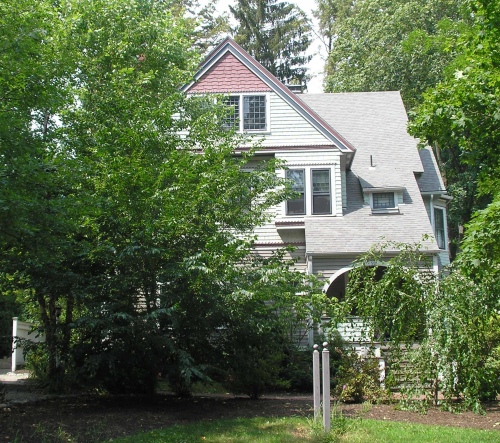
Below is a picture of ED's home in Amherst, MA.

 Although ED did not marry, perhaps because she did not marry, she experienced several intense relationships.  In my previous entry, I mentioned her intimacy with her sister-in-law, Sue, and then with editor, writer, and abolitionist Thomas Wentworth Higginson.  ED's relationship with married newspaper editor Samuel Bowles could be described as an entanglement.  She sent this poem to him.  Could it be about their relationship?  Or, as Gordon suggests, could it be a persona poem?

http://www.kalliope.org/digt.pl?longdid=dickinson200108301072

Her correspondence with classmates is both compelling and awkward.  Frequently, her classmates chose not to respond to her.  Later in life, after her father's death, she became involved with his friend and colleague, Judge Otis Lord, a widower.  Her letters to him are lively, charming, and more down-to-earth.  The couple even discussed marriage, but it was not to be.  Below is a picture of Judge Lord.


I also like how Gordon discusses ED's year at Mount Holyoke Seminary, the first American college for women (pictured above).  Academically, her year was successful as the future poet thrived on the college's challenging curriculum.  (She studied geology, chemistry, and astronomy among other courses.)  However, the college's emphasis on evangelical Christianity isolated ED, for she was very much a skeptic and resisted the college president's attempt to convert the student body en masse.  Worse, the college president encouraged students to spy on each other and discouraged them from forming close friendships.  ED's roommate and cousin, Emily Norcross, spied on her.  Eventually, ED left the college due to "ill health."  Does stress bring on seizures?


I did not forget the Todds!  It was very hard for me to find a picture of this family: the bewitching Mabel Loomis Todd; her husband, David, a professor of astronomy at Amherst College; and their daughter, Millicent Todd (later Bingham), who continued her mother's work on a more scholarly note.  Instead, I found the cover of a collection of Mabel's correspondence with her lover and ED's brother, Austin Dickinson.


Married to a very junior professor at Amherst who was also unfaithful to her, Mabel Loomis Todd was a bright, beautiful young woman in search of...something!  Initially, she was Sue Dickinson's protege, but then her flirtatious ways attracted first Sue's son--and then Sue's husband.  (Where is Carolyn Hax when you need her?)  Mabel also wanted to become friends with ED herself but was unable to.  However, after the poet's death, she helped ED's sister Lavinia transcribe the poems for a collection.  Mabel's role in the collection became greater and greater even as she strove to alienate her lover from his wife and children and to "feather" her family's nest.  (Austin Dickinson was a wealthy, powerful lawyer in Amherst and the college's treasurer.  Ironically, he didn't recognize his sister's greatness, but he did help his lover's husband.)  I must add, though, that Lavinia didn't pay Mabel and that she didn't recognize how much the younger woman did.


Ultimately, after her lover's death and the publication of two volumes of poetry, Mabel attempted to wrest a parcel of land away from his family.  Below is a picture of the Todds' house.  It was recently a bed and breakfast but appears to have closed.  (On one site, it was rated 13th of 14 inns in Amherst.)


Back to my story...In order to get the land she wanted, Mabel had to first get Lavinia's signature on a deed...as it turned out...under questionable circumstances.  It goes without saying Lavinia and Mabel could no longer work together.  They went to court over the signature.  Lavinia won the suit and its appeal; Mabel locked away the poems and letters that she had been working on.  This was in 1898.

By the way, here is a picture from a 2000 recreation of Mabel and her husband's presentations on their expeditions together.  One was to Japan where she climbed up to the sixth stage of Mt. Fuji, a remarkable feat for a woman of those days.


The picture below is of a 1906 *summer* climb of Mt. Fuji.


For many years, in fact, over the course of much of the 1900s, the Todds and the Dickinsons fought over ED's work and her public image.  Mabel Loomis Todd's editing was heavy handed by our standards, and she fought to slander Sue Dickinson's character and diminish her role in ED's life, but she did much to promote the poet's work, including lecturing on it.  Her daughter, Millicent Todd Bingham, a professor of geography, continued the task of promoting ED's work--and her mother's work after MLT died in 1932.  She also argued against Martha Dickinson Bianchi's attempts to romanticize her aunt's life.  However, MDB's 1914 edition of her aunt's poetry and her subsequent biography drew readers' attention to ED's poetry.  Moreover, the critical climate in the early 1900s was more receptive than it had been in the 1890s.  A romance novelist, MDB provided her aunt's story with a master narrative: one unhappy love affair had caused her to retreat from society and write poetry.  MTB, on the other hand, specifically argued against this master narrative.  She published ED's letters to Judge Lord as part of her argument, and she encouraged Yale professor Richard Sewell to write a scholarly biography of ED.  This two-volume biography would appear in 1974.  Then readers and scholars would be even more receptive to ED and her work.

I'll close with a picture of Sewell's book


and of some pictures from the Emily Dickinson Museum in Amherst, MA.

This picture shows more of the museum's gardens.


Below is a picture of Emily Dickinson's bedroom.


Finally, below is the cover of the first edition of ED's poems.  The painting on the cover is by Mabel Todd Loomis.


Emily Dickinson & Thomas Wentworth Higginson


Emily Dickinson's life has intrigued many people over the years.  Why did she withdraw from society, refusing to "cross [her] Father's ground to any House or town"?  Why did she write such strangely compelling poetry?  Who inspired her?

One popular reimagining of ED is William Luce's 1976 play The Belle of Amherst.  (The picture below is from a recent production.)


You may also see part of Jennifer Levinson's performance at this video linked below:
http://www.youtube.com/watch?v=fz8girAKwJM

Others are intrigued by ED's relationship to her sister-in-law, Sue.


http://santitafarella.wordpress.com/2008/07/15/emily-dickinson-lesbian-her-letter-to-susan-gilbert-in-june-of-1852-might-tell-us-less-than-you-think/

http://www.emilydickinsonmuseum.org/ed/node/78

Brenda Wineapple has decided to examine ED's friendship with poet, editor, and abolitionist Thomas Wentworth Higginson.  As she points out, often people have wondered just what ED saw in Higginson.  He has been caricatured as the man who tried to regularize ED's poetry.  After all, his poetry tended to be carefully crafted sonnets, and his most well-known poems today are translations of Petrarch, the 14th century Italian poet known for his love poems to Laura, a woman he never actually met.

http://www.sonnets.org/petrarch.htm#010

http://www.sonnets.org/petrarch.htm#020

Also, take a look at the cover of White Heat above.  How old does she look?  What comes to mind when you look at her?  when you look at her next to the middle-aged man with facial hair and a military uniform?


It is one of the few photographs of ED.  True.  It was taken when she was a teenager.  She began to write to TWH when she was thirty.  Without fooling around with her existing photographs (which in itself is trouble and which ED's family did do), we will always have a distorted view of ED (and therefore of her relationship to TWH) if we focus on the photographs.  I don't know what I would have placed on the cover of White Heat, but something less direct and more evocative might have been better.

However, Higginson was more than "just" a translator and magazine editor, and his relationship with ED was fairly complex.  Wineapple notes its sexual tension.  Today we might consider their relationship to be an emotional affair and even emotional infidelity as TWH was married to a chronically-ill woman at the time.  Wineapple also speculates about what he gained from ED as well as about what she gained from him.  Moreover, as Wineapple points out, ED consciously chose Higginson as her mentor, for she would have been familiar with his work for the Atlantic Monthly as well as his political activism.  This is not to say that ED was politically radical or even engaged with politics.  Some of the tension in her relationship with TWH occurs when she downplays his desire to fight in the Civil War.  (He ultimately trained African-American soldiers in South Carolina.)  She was much more interested in TWH's nature writing, and her family was relatively conservative.


Below is Frederic Edwin Church's painting of Mount Katahdin in Maine, one of the many subjects of TWH's nature writing.


 However, TWH tended to examine nature closely.  A more typical topic for him would be the water lily (shown below):


As you'll note from these poems, ED also likes to examine nature closely.

http://www.poets.org/viewmedia.php/prmMID/20949

http://www.poetryfoundation.org/archive/poem.html?id=180204


http://www.tcnj.edu/~carney/dickinson/poems.html#did_the_harebell


Yet Wineapple is persuasive in her readings of ED's poems with imagery relevant to the Civil War.  See these links for a few of these poems:  

Apologies for any pop-ups!

http://www.americanpoems.com/poets/emilydickinson/10548

http://en.wikisource.org/wiki/My_Portion_is_Defeat_%E2%80%94_today_%E2%80%94


Below is a picture of Glory, a 1989 film about the company that Higginson had wanted to command.


ED and TWH's friendship began in 1862 and continued through the rest of her life despite his remarriage to a much younger woman and her intriguing relationship with Judge Otis Lord.  ED & TWH's correspondence periodically slowed, but she would send him her poems, referring to herself as his "Pupil" as late as 1884, the year before her death.  Interestingly, even then, she also toyed with submitting her poems for publication when another of TWH's proteges, Helen Hunt Jackson, contacted her about submitting them to The No Name Series.  ED sent Jackson one poem, "Success is counted sweetest":
http://www.poetryfoundation.org/archive/poem.html?id=174990

This poem would be published...anonymously.

After her death, TWH co-edited her poems with Mabel Loomis Todd, the mistress of ED's brother.  Todd, as it turns out, was responsible for the "regularization" of ED's poems.  TWH was more of an advocate, convincing Todd to include particular poems and writing the preface to the collected poems.  Initially, this project was successful, but 19th century readers were not quite ready for Dickinson, and Lavinia Dickinson, ED's sister and heir, soon quarreled with both Todd and TWH.  

Below is a link to a version of TWH's preface that appeared in the October 1891 issue of The Atlantic Monthly.  Beneath the Victorian verbiage, he quotes freely from ED's poems and letters:

http://www.theatlantic.com/past/docs/unbound/poetry/emilyd/edletter.htm

I'll close with a picture from the garden at the Emily Dickinson Museum in Amherst, MA.  During her lifetime, ED was also known as a gardener.

Friday, March 28, 2014

Questions After 3/28


Above is a picture of Julie Harris as Emily Dickinson in "The Belle of Amherst."

Good evening :)

Just a reminder that the DC Poetry Project will be screening "The Belle of Amherst" tomorrow (Sat) from 12 noon to 2 pm in HU 002.  Hope to see you there!

Here are some poems by Emily Dickinson, the "Belle" herself:


Then, on Monday, we will head up to the library to work with Ms. Niyati Pandya.

Wednesday we will return to our regular classroom, and I believe that we may have a presentation!  In addition, I have made a change in readings.  Next week I would like to return to more chronological order with poems by Wheatley and John Dickinson as well as Irving’s “Rip Van Winkle,” Longstreet’s “The Dance,” Sedgwick’s “Cacoethes Scribendi,” andSchoolcraft’s “Mishosha.”

Here are a few questions for your journals:

-- Which types of writing are more effective for social criticism?  Why?

-- Discuss Douglass' depiction of religion.  

-- Consider the impact of his narrative's Appendix, especially its  "Parody."  Does "Parody" support his profession that he is not against Christianity?  Or does it undercut it?  Why?  Why not?

-- Discuss Douglass' initial attempt to escape.  How did its failure appear to affect him?  Why did he and Sandy realize that they had been betrayed?  Who do you think betrayed them?

-- Discuss Douglass' battle with Covey.  How does it affect Douglass?  How does it affect Covey?

-- What is it like for you to return to poetry with Wheatley, Emily Dickinson, and John Dickinson?

-- What is it like for you to turn to fiction with Washington Irving's "Rip Van Winkle"?

-- What do these works add to American literature?

-- What does Douglass' Narrative add to American literature?

Also, here is a link to Miriam's presentation:
http://prezi.com/e2aehsjeqv64/the-navajo-people/

What does she add to your understanding of Native American culture?  of the Navajo?

What was the most intriguing thing that you learned from her presentation?  Why?

What would you like to present on?

See you at the screening--or at the library!

Wednesday, March 26, 2014

Questions After 3/26 Class


Good evening :)

First of all, I want to send you the tutorials for Ms. Pandya's class on Monday.  If you have taken her class or another librarian's class before, just skim over the tutorials to review.

Here they are.  


Also, on Friday, Miriam will present, and we will finish up Frederick Douglass' Narrative.  Next week we will move on to Harriet Jacobs' lifewriting and Phillis Wheatley's poetry.

Here are a few questions:

-- Compare/contrast Douglass' experience of slavery with Equiano's.

-- Compare/contrast how Douglass escaped slavery with how Equiano purchased his freedom.

-- Compare/contrast how each narrator engages with his audience.

-- Compare/contrast how each author presents his characters.

-- Compare/contrast how each author presents slavery.

-- How does Douglass depict the impact of slavery?

-- How does Douglass depict humans' desire for power and the effect of power?

-- How does he show that his narrative is truthful?

-- What is it like for Douglass to return to the country?

-- What is it like for him to live in the city?

-- What is it like for him to leave the South?

-- Compare the South & North at this time.

-- Here James Earl Jones reads excerpts from Douglass' speech for the 4th of July:  https://www.youtube.com/watch?v=8tTkHJWxfP0
What does this speech add to your understanding of the Narrative?
What does it add to your understanding of the Narrative's historical context?
How does Douglass represent America?  How does this speech fit into the concept of American identity?

-- What do you think about the idea of there being conventions in the slave narrative?  Is this a good thing?  Or a bad thing?  Why?  Why not?  How does this affect the truthfulness of a narrative?

-- If you are an education major, discuss the differences between teaching more traditional forms of literature and teaching life writing & narratives of exploration.

I am looking forward to seeing what you have to say!

Dr. Szlyk