Showing posts with label museums. Show all posts

Thursday, August 28, 2008

Field Trip for Fall 2008

Link

Just to let you know that you're invited to join my world literature class on our field trip to see an exhibit of Indian paintings at the Smithsonian.  (The picture above is an example of the type of work we will see.)  The field trip will be on Saturday, November 1.  For more information, check the link above.  Hope to see you there.  

Thursday, April 3, 2008

Our Visit to the Freer Gallery (March 29)

  Now that I have a little bit of time this morning, I'd like to post a quick entry on last Saturday's trip to the Freer Gallery and, of course, thank those of you who were able to venture out to the city on a Saturday, a very crowded Saturday!  For those of you who weren't able to venture out, fortunately, most of what we saw was from the permanent collection, so it's likely that you'll be able to see some of what we saw on our trip.

On the other hand, we did have a docent who gave us a tour.  I highly recommend it as he had visited many of the countries whose art we saw and he was able to slow us down!  Speaking from experience, I've found that it is easier and easier to dash through a museum and see nothing.   More importantly, though, the docent emphasized sculpture and illuminated manuscripts, types of art that I am usually not drawn to but that are important to an understanding of Asian culture.  So, here is a link to the Freer and Sackler Galleries' information about their tours.

http://www.asia.si.edu/visitor/tours.htm

Again, I highly recommend going on one of these tours, especially if you are new to museumgoing, but also if you are experienced.

But back to our tour...we began by examining an enormous guardian figure from a Japanese temple.  The docent explained that at one point the figure had been painted but that over the years the paint had worn away.  He also informed us that the figure had been made in parts.  Then he showed us that the figure's arms were mismatched.  Unfortunately, the Freer does not have a picture of this particular figure, but here is a link to a picture of a similar figure and information about it:

http://www.asia.si.edu/collections/singleObject.cfm?ObjectId=11859


Next we moved on to an exhibit on Islamic art where we saw a mihrab, a panel that would have indicated the direction of Mecca to worshippers in a mosque.  Here is a link to the picture of the mihrab.

http://www.asia.si.edu/collections/singleObject.cfm?ObjectId=4811

We also looked at pages from the Koran, some dating from the ninth century CE!  The docent explained to us how Arabic script had changed over the years.  Here is an example of one of the earliest manuscripts.  It is written in kufic script, a style that looks very different from modern script!

http://www.asia.si.edu/collections/singleObject.cfm?ObjectId=9837

To preserve these manuscripts, the museum severely limits the period of time that they are on display.  A manuscript may be shown for only a month at a time!  In turn, this means that there is always something new and different to look at in this gallery.

We also saw metalwork bowls, one of which combined Christian and Islamic imagery.  This link below is not to this bowl, but it is to a tile that draws on Jewish imagery (the Star of David):

http://www.asia.si.edu/collections/singleObject.cfm?ObjectId=1944

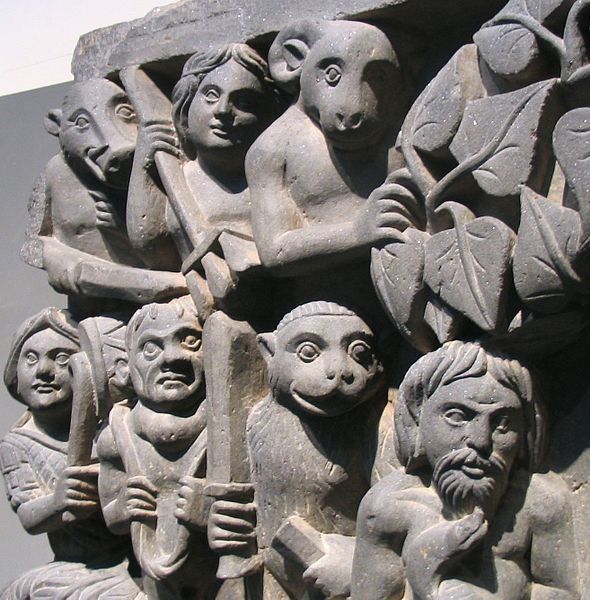
Next we saw examples of Buddhist art.  Our docent explained that up until the first century CE artists did NOT depict the Buddha.  Then, at that time, they began to depict him.  Here are outside links to a frieze depicting the Buddha's life:

http://www.arthist.umn.edu/aict/html/non_west/IND/IND009.html

http://upload.wikimedia.org/wikipedia/commons/thumb/e/ed/Four_Scenes_from_the_Life_of_the_Buddha_1.jpg/590px-Four_Scenes_from_the_Life_of_the_Buddha_1.jpg

The frieze was carved in Afghanistan, which is not surprising as Buddhism quickly became an international religion.  However, our docent noted that the sculptors of the frieze may have been Greek or Persian as their style was more Greek.  He then pointed out a figure wearing armor that seemed more appropriate to the Iliad than to the life of the Buddha. 

Here is a link from Ohio State about another frieze from India.  This page is quite informative.

http://kaladarshan.arts.ohio-state.edu/studypages/internal/dl/SouthAsia/Buddhist/pgs/u5/DL0209m.htm

We also looked at examples of Hindu art.  Unfortunately, we did not see any figures of Ganesh!  But here is an especially striking bronze of the god Shiva.  It is from the tenth century CE:

http://www.asia.si.edu/collections/singleObject.cfm?ObjectId=38637

This statue is a bronze of a devout queen as the goddess Parvati.  Our docent noted that a statue in a temple usually would have been garlanded and even clothed.
http://www.asia.si.edu/collections/singleObject.cfm?ObjectId=9849

Finally, here is a later statue of a child saint:

http://www.asia.si.edu/collections/singleObject.cfm?ObjectId=11802

We also saw some Japanese screens.  These were not on display, but the Freer owns some that depict scenes from The Tale of Genji:

http://www.asia.si.edu/collections/singleObject.cfm?ObjectId=39454


http://www.asia.si.edu/collections/singleObject.cfm?ObjectId=46858


http://www.asia.si.edu/collections/singleObject.cfm?ObjectId=46859

Below is a nineteenth-century scroll also depicting a scene from the novel:

http://www.asia.si.edu/collections/singleObject.cfm?ObjectId=28475


The Freer Gallery also contains the Peacock Room, which was designed by the influential artist James McNeill Whistler.  Did you know that he attended West Point for a year or so?

http://www.asia.si.edu/collections/singleObject.cfm?ObjectId=2122


Below are some of Whistler's works that we saw.  Note that they show the influence of Japanese art:

http://www.asia.si.edu/collections/singleObject.cfm?ObjectId=1924


http://www.asia.si.edu/collections/singleObject.cfm?ObjectId=151

To compare, here is a link to an 1859 work by American painter Frederic Edwin Church:

http://commons.wikimedia.org/wiki/Image:Church_Heart_of_the_Andes.jpg

This painting by Winslow Homer is from 1876, around the time that Whistler was working on "The Balcony" (see above):

http://commons.wikimedia.org/wiki/Image:Winslow_Homer_003.jpg

We concluded with a visit to an exhibit of Chinese paintings with literary themes:

http://www.asia.si.edu/exhibitions/current/talescont.htm

Hope you enjoyed this entry on our visit to the Freer Gallery!

Thursday, January 31, 2008

African Art

To finish up for now (Thursday), I'd like to add some links to exhibits on African art.  When we visit the Freer Gallery in March, if we have time or inclination, we may be able to visit the nearby Museum of African Art.  However, while we are reading Heart of Darkness and later on when we are reading Olaudah Equiano's Interesting Narrative and Mariama Ba's So Long a Letter, I'd like for you to be able to look at the links below.  By the way, the picture above is of a power figure from the Congo.  In fact, the figure dates from the 19th century!!  In your opinion, what would Marlow have made of such a figure?

(Here I've posted a copy of a British painting from 1912 as contrast.  J.W. Waterhouse is not the most avant-garde of artists, but his Penelope and Her Suitors may give you an idea of what people in the early 20th century were used to considering as art and why African art might have been shocking to them.)

For more information about the African power figure and its context, see the link below from the Brooklyn Museum:

http://www.brooklynmuseum.org/collections/african_art/22.1421.php

This link takes you to information about that museum's entire collection:

http://www.brooklynmuseum.org/collections/african_art/

Just twenty five years after Heart of Darkness' serialization, the Brooklyn Museum presented an exhibit of African art.  At this time, this art was influencing European artists such as Picasso.

http://www.brooklynmuseum.org/research/digital-collections/pna1923/


Closer to home, here are some links to the Smithsonian's Museum of African Art:

http://africa.si.edu/exhibits/africanvision/index2.html


http://africa.si.edu/collections/index.htm

In 1993, the Bayly Museum of Art at the University of Virginia set up an electronic exhibit on African art:

http://www.lib.virginia.edu/clemons/RMC/exhib/93.ray.aa/African.html


NYC has a Museum for African Art.  Currently, it is based in Long Island City, but it will soon be moving to a new home in Manhattan.

http://www.africanart.org/index.php


The Guggenheim Museum includes a searchable map of Africa on its web site.  Here are links to its pages on Central Africa (the region where the Congo is) and Western Africa (the region where Senegal and Nigeria are).

http://artnetweb.com/guggenheim/africa/central.html


http://artnetweb.com/guggenheim/africa/west.html

The Guggenheim also has a page on African film.  Unfortunately, it seems to have been written in the 1990s:

http://www.artnetweb.com/guggenheim/film/


Here is some background information on African art from a web site at Sweet Briar College in Virginia:

http://www.uiowa.edu/~africart/teachers/Chronology.html


http://hum.lss.wisc.edu/hjdrewal/Looking.html

http://hum.lss.wisc.edu/hjdrewal/aesthetics.html

Anne-Marie O'Connor from the LA Times writes here about the ongoing reassessment of African art:

http://www.calendarlive.com/galleriesandmuseums/cl-et-africanart29jan29,0,5808956.story

This is a little off topic, but I thought that you might be interested in this essay on African history from NYC's Metropolitan Museum of Art:

http://www.metmuseum.org/toah/hd/ahis/hd_ahis.htm


I'd like to close with a site from Senegal's DAK'ART Biennale.  It is in French.  The next exhibition will be this summer, so if you plan to go to Dakar....

http://www.biennaledakar.org/

Wednesday, January 2, 2008

Dream of the Red Chamber/Story of the Stone

One of the novels that we will be reading excerpts from in EN 202 is The Dream of the Red Chamber (or The Story of the Stone). 


Here is American poet Kenneth Rexroth's discussion of this novel.  Note that we are reading excerpts of excerpts of a novel! Also, he spells the characters' names differently as in his time they were transliterated from the Chinese differently.  Beijing, for example, was Peking.   As you may have noticed in the entry on the novel continued, Rexroth is a strong advocate of world literature. 

http://www.bopsecrets.org/rexroth/cr/7.htm#The%20Dream%20of%20the%20Red%20Chamber

This introduction (a translation of a German translation) is useful even though it is difficult to read.  However, it provides some important background on the author(s) and his/their work:

http://www.scu.edu.tw/english/teachers/steelman/steelman/kuhn000.htm

This overview from Purdue is shorter, clearer, and less argumentative:

http://www.fll.purdue.edu/Chinese/Honglou/intro.html

More practically, here is an outline of the novel and its characters:

http://www.wku.edu/~yuanh/China/tales/lindaiyu_b.htm

The picture below is from a Chinese television network (TV B)'s adaptation of the novel.  Interestingly, there are no men in this picture.


Here are pictures of the characters:

http://www.fll.purdue.edu/Chinese/Honglou/characters.html

A professor of Chinese talks about his experience teaching Dream of the Red Chamber:

http://web.archive.org/web/20080124160954/http://www.cityu.edu.hk/ccs/Newsletter/newsletter2/Red.htm

In 2000, the Oglethorpe University Museum of Art held an exhibit of An Ho's art inspired by the Dream of the Red Chamber:

http://museum.oglethorpe.edu/RedChamber.htm


In 1977, the Hong Kong film producer Run Run Shaw made a movie of Dream of the Red Chamber.  Interestingly, the role of Bao Yu was played by a woman!  The picture at the top of this entry is from this film.

http://www.dragonsdenuk.com/reviews/dream_of_red_chamber.htm

For more information (and pictures), see this web site:

http://www.brns.com/pages4/blin16.html


For more information about Cao Xueqin, one of the authors of Dream of the Red Chamber:

http://anywherechina.com/history/historical_figures/caoxueqin/caoxueqin.htm


If you are ever in Beijing, you may want to go to the Cao Xueqin Memorial Hall (see above):

http://www.10thnpc.org.cn/english/features/museums/139507.htm


Prince Gong's Mansion (see above) may have been the original for Bao Yu's home:

http://www.chinatour.com/attraction/beijing/gong-wang-fu-gong's-mansion-garden.htm

Preserving palaces like Prince Gong's can be difficult:

http://web.archive.org/web/20080210073252/http://www.ebeijing.gov.cn/HomeBj/Hutong/HTOUR/t171490.htm

For more information about Confucianism,

http://www.askasia.org/teachers/essays/essay.php?no=38


For more information about Daoism,

http://www.askasia.org/teachers/essays/essay.php?no=40&PHPSESSID=cf3a1e7b0f8e79502f7f76f32db9f031


For more information about Chinese Buddhism,

http://www.hinduwebsite.com/buddhism/chinese_buddhism.asp

http://depts.washington.edu/chinaciv/bud/5budhism.htm