Showing posts with label dc. Show all posts

Saturday, February 11, 2012

Local Theater -- Red

My husband and I have also been attending performances of contemporary drama.  Last weekend we saw Red at Arena Stage, another impressive venue.  This venue, however, is quite 21st century.

Red's subject matter is also quite modern and fits into our course nicely.  The play is about modern artist Mark Rothko.

You may prefer to see his distinctive paintings in color.

The play is set in the late 1950s when Rothko was completing a commission to paint murals for The Four Seasons, a very expensive restaurant in NYC.  Rothko's style of painting was also being challenged by the work of artists such as Andy Warhol.  In the play itself, Rothko and his assistant, Ken, a young artist, battle over art and its meaning.  I wonder how this play would work as drama read in a class like EN 230.  However, visual and aural elements that may be difficult to convey on the page are so important to this play in particular.  (It is set in Rothko's studio, a capacious loft with much equipment and many paintings in progress.)  Also, as my brother-in-law pointed out to me, this play would be difficult to stage in many settings and requires a venue and company like Arena Stage or its equivalent.  For more information, see this article from The NY Times:


The scene below is from Arena Stage.


Even the paint that Rothko and Ken throw around the stage requires technical know-how.  After all, oil paint is very permanent.  Yet, in one scene, Ken cleans it up very quickly.

For reviews of Red at Arena Stage, see the following links:


Links to reviews of other productions are below:


For information about Rothko, see the links below:


And what did happen to the murals that Rothko was supposed to paint for the Four Seasons:


To finish, here are links to videos and articles about what it is like to perform in Red.


The scene below is from Boston's Speakeasy Theater:

Local Theater -- The Gaming Table


Although Susanna Centlivre wrote The Basset Table...I mean...The Gaming Table long before our era begins in EN 230, I'd like to post a quick review of the performance my husband and I saw today at the Folger Theater in DC.

One of the advantages of living near DC is the ability to see performances of plays that are no longer performed as often.  The Folger Theater is a particularly suitable venue.  The two-story stage with its sweeping, wooden staircase represented an eighteenth-century London mansion in a way that a more typical stage might not.

This performance reminded me that Restoration comedy is fun to read--and watch.  The performance was fun and funny without being condescending or condescended to.  Neither did it creak.  The actors were skillful, and parts of the play were discreetly updated here and there.  Since we associate basset with dogs rather than with cards, the play's title became The Gaming Table.  After all, the play is about women who gamble on cards, love, and men.  The prologue and epilogue included references to Congress and women's roles today.

Like many Restoration comedies, The Gaming Table brings together several couples in a merry round of romance.  Centlivre gives us four to be exact.  First is Lady Reveller, a spunky widow, and her beau Worthy, who wants her to give up gambling.  Next is her cousin Lady Lucy, a serious young lady who prefers the playhouse to the gaming table, and Sir James Courtly, a not-so-serious man.  Another cousin, Valeria, would seem to prefer science to love...except that she is in love with the charming Ensign Lovely.  And then there are Mr. and Mrs. Sago, Pud and Kiki...except that she appears to love gaming and Sir James more than she loves her husband.  Other characters throw in complications.  Valeria's father intends for her to marry Captain Hearty who would rather not marry her.  And then there are Buckle and Alpiew, the servants of Worthy and Lady Reveller respectively.

But all's well in the end.

Here are links to a few reviews of The Gaming Table:


For more information about the play itself, see The Folger Theater's website:


For more information about Susanna Centlivre who wrote The Basset Table in 1705, see these links:


See these links for a review of an earlier revival of The Basset Table:


UMBC has a podcast of a performance:


Chicago's Alcyone Festival in 2008 included a performance of another of Centlivre's plays:

The Busy Body was staged in NYC in 2010:

The blog entry above has many pictures!

The Wonder was also staged in NYC.  This appears to be a more modern version.


Sunday, June 7, 2009

After Going to See Mother Courage!

At long last!  Today (6/7) I was able to see Mother Courage at the Clark Street Playhouse in Virginia.  I have wanted to see Brecht's play for a while.  My husband and I were actually supposed to go last Sunday, but the matinee was canceled...due to a bike race.  

The picture above is of Colleen Delany (Kattrin) and Nancy Robinette (Mother Courage).  By the way, the Post gave Ms. Robinette quite a rave review:

http://www.washingtonpost.com/wp-dyn/content/article/2009/06/03/AR2009060303294.html

Here's a picture of the theater.  It is incredibly hard to find either on foot or by car, so it's no wonder that the bike race could cut off access to it.


The inside of this playhouse is just as funky, which fits Mother Courage, a play set on the battlefields of the Thirty Years War.  Also, Mother Courage is not intended to be a painfully historical or realistic play.  Even though it is set in the 17th century, historical and geographical details are not that important.  Mother Courage and her children might as well be on a treadmill as the years go by.   I would also say that Scena Theater's production was particularly austere.  Compare these two productions below.  The first is from a 2004 production that appeared in several cities in the UK and was set in modern-day Africa.  Another is from Cambridge (MA)'s American Repertory Theater.


However, an elaborate set or central idea is not always a sign of a fantastic production:

http://tech.mit.edu/V121/N11/Mother_Courage_.11a.html


http://www.bostonphoenix.com/boston/arts/theater/documents/00630946.htm

In Scena Theater's production that I saw, the play was staged on a concrete floor while the audience sat above in bleacher seats...ok...not quite bleacher seats.  The seats had backs.  The actors used all of the stage and more.  In fact, as the play began, the two army recruiters sat among the audience and spoke the first of their first lines there.  It was not until Mother Courage's sons Eiliff and Swiss Cheese pulled her cart out from the wings that the recruiters joined them on stage.  The cart was quite sizable, by the way.  It opened up so that Mother Courage and Kattrin could stand inside serving drinks in one scene.

Imagine the truck above without its engine and with a long pole with a long handle instead.

But what was it like to hear and see the actors performing the play?

I think that a performance of Mother Courage moves more quickly than one thinks if one has only read the play.  The scenes really fit together in performance.  Of course, this production showed information about each scene as well on screens well above the actors' heads.  However, watching the play, I saw how much the characters' situation changed and how much it remained the same.

Surprisingly, the songs did not jump out from this presentation, which detracted from more than one scene.  To compare, here is a link to Antaeus Theater's version of Mother Courage:

http://www.youtube.com/watch?v=SUmpBu_qkD0


Probably the actors at Antaeus were miked.  Or Scena's taped music overwhelmed the singing of the live actors.  Or the Clark Street Playhouse is a little too intimate, which discourages the actors from projecting.  Mother Courage has been performed in more formal settings as in the picture of the University of Denver's production from 1985 (see below).  I'm not sure which.  It may even help to carry a tambourine as the actors at Antaeus do.


A number of scenes play differently in real life.  The scene right before Kattrin's death is a lot less sentimental than I imagined it.  The peasant woman telling Kattrin to pray is basically telling her to get lost.  Nancy Robinette's Mother Courage also seems to love her children more than I imagined her to, which affects the scene in which she is bargaining for Swiss Cheese's life or when she is reunited with Eiliff or when she responds to the attack on Kattrin.

However, as this picture from Yale University's production shows, actors do represent Mother Courage as more emotional and less hard-bitten -- despite playwright Bertolt Brecht's strictures.


My impression of various characters changed as I saw them in performance.  Joe Baker's Eiliff seemed more hostile and less stiffly heroic.  Rashard Harrison's Swiss Cheese was more bumbling.  Of course, since she is mute, Kattrin's role enlarges in performance.  I was really surprised by how much she aged in this production.  At the beginning, she was very sprightly and childish, but by the end, she was quite weary and moved very slowly until of course she broke away from the peasants to beat the drum warning the villagers.  If I were to watch this or another company's performance, I would play closer attention to the actor playing Kattrin.   (I couldn't find another picture of Colleen Delany as Kattrin, but here is a picture of Hilary Burns, a British actor, in that same role.

I happened to see someone videotaping the production.  Perhaps some scenes will end up on YouTube.  They would be useful for someone wanting to see a professional yet less distracting version of Mother Courage.  I wish that I had been able to go to Charlottesville last year or to the American Repertory Theater back in 2001.


Sunday, June 8, 2008

Waiting for Godot at the Warehouse Theater

This afternoon my husband and I went out in the insane heat to see Samuel Beckett's Waiting for Godot at DC's Warehouse Theater, a gritty venue north of Gallery Place/Chinatown.  This play may not quite be the kind of contemporary play that the City Paper's critics would like to see more of, but I thought that it was well worth reviewing for the EN 202 blog.  Moreover, Waiting for Godot has been an extremely influential play, even from its first performances.

Did you know that Waiting for Godot was originally in French?  Its author, Samuel Beckett, was born in Ireland, but he chose to write in French (after WWII) because that language enabled him to "write 'without style.'"  (At the time, he was living in Paris.)  Beckett then translated his play into English, his first language.

The premise of Waiting for Godot is this: two men Vladimir or "Didi" and Estragon or "Gogo" are waiting in a field by a tree because Godot, a man who has agreed to help them out, has said that he would be coming there.  It's not clear where the men are or when the play takes place.  At one point, Vladimir and Estragon talk about picking grapes somewhere in France and being together for fifty years.  However, this is not a realistic play.  In fact, critic Normand Berlin notes that Beckett refused to answer famed theater actor Ralph Richardson's questions about the characters in his play.  For Berlin himself, the absence of specificity or backstory was exciting, and he views the two characters as archetypes.

Along the way, Vladimir and Estragon chat to kill time.  At times, they discuss very mundane matters, and Estragon grumbles about his ill-fitting boots.  Then he turns around and suggests to his companion that they hang themselves on the tree.  They do not because they have no rope with them.  They also motivate themselves to wait for Godot and, at one point, mistake Pozzo, a wealthy man with a slave named Lucky, for him.  One of Godot's servants then arrives, informing the two men that his master will not be coming.  After a brief intermission, the play begins again, and it is the next day--or is it?  First Vladimir and then Estragon return to the stage.  Vladimir is cheerful, trying to remember a song about a dog; the other man straggles in, without shoes and with scrapes and bruises from a fight.  The two men reconcile and talk about going off separately.  Again Pozzo comes on stage.  This time he is blind, his slave is mute, and both helplessly fall down onto the ground.  They need Vladimir and Estragon's help to get up.  Again Godot's servant comes on stage.  He does not recognize Vladimir or Estragon even though Vladimir begs him to.  The servant leaves, followed by the two men.

The actors at the Scena Theater (Chris Davenport and Dan Brick) look relatively young as you may gather from the picture above.  Here are some pictures of other pairs.  James Laurenson and Alan Dobie portray a more elderly pair.

Charles Spencer's review is also well worth reading as he discusses the difficulties of staging Godot in the 2000s, more than fifty years after the play's exhilarating debut:

http://www.telegraph.co.uk/arts/main.jhtml?xml=/arts/2006/10/11/btgodot11.xml


The Classical Theater of Harlem traveled to New Orleans to perform Waiting for Godot.  Mother Jones' Nick Baumann has written about their open-air performance:

http://www.motherjones.com/arts/feature/2007/11/waiting-for-godot-in-new-orleans.html

Colleges like Wichita State University in Kansas and Montreal's McGill University have staged this play as well.  The photo below from Wichita State shows Lucky and Pozzo as well as Vladimir and Estragon.  Lucky is the young woman with the bags.

The picture below is from McGill's performance:

  For more information about this production, see this link:  http://media.www.mcgilltribune.com/media/storage/paper234/news/2004/02/10/AE/Two-Guys.And.A.Tree-603040.shtml

The picture below is from a 1984 bilingual production (Hebrew and Arabic) staged in Haifa, Israel

  I will close with a link to Normand  Berlin's article that truly puts Beckett and Godot in context:

http://www.samuel-beckett.net/BerlinTraffic.html

Thursday, April 3, 2008

Our Visit to the Freer Gallery (March 29)

  Now that I have a little bit of time this morning, I'd like to post a quick entry on last Saturday's trip to the Freer Gallery and, of course, thank those of you who were able to venture out to the city on a Saturday, a very crowded Saturday!  For those of you who weren't able to venture out, fortunately, most of what we saw was from the permanent collection, so it's likely that you'll be able to see some of what we saw on our trip.

On the other hand, we did have a docent who gave us a tour.  I highly recommend it as he had visited many of the countries whose art we saw and he was able to slow us down!  Speaking from experience, I've found that it is easier and easier to dash through a museum and see nothing.   More importantly, though, the docent emphasized sculpture and illuminated manuscripts, types of art that I am usually not drawn to but that are important to an understanding of Asian culture.  So, here is a link to the Freer and Sackler Galleries' information about their tours.

http://www.asia.si.edu/visitor/tours.htm

Again, I highly recommend going on one of these tours, especially if you are new to museumgoing, but also if you are experienced.

But back to our tour...we began by examining an enormous guardian figure from a Japanese temple.  The docent explained that at one point the figure had been painted but that over the years the paint had worn away.  He also informed us that the figure had been made in parts.  Then he showed us that the figure's arms were mismatched.  Unfortunately, the Freer does not have a picture of this particular figure, but here is a link to a picture of a similar figure and information about it:

http://www.asia.si.edu/collections/singleObject.cfm?ObjectId=11859


Next we moved on to an exhibit on Islamic art where we saw a mihrab, a panel that would have indicated the direction of Mecca to worshippers in a mosque.  Here is a link to the picture of the mihrab.

http://www.asia.si.edu/collections/singleObject.cfm?ObjectId=4811

We also looked at pages from the Koran, some dating from the ninth century CE!  The docent explained to us how Arabic script had changed over the years.  Here is an example of one of the earliest manuscripts.  It is written in kufic script, a style that looks very different from modern script!

http://www.asia.si.edu/collections/singleObject.cfm?ObjectId=9837

To preserve these manuscripts, the museum severely limits the period of time that they are on display.  A manuscript may be shown for only a month at a time!  In turn, this means that there is always something new and different to look at in this gallery.

We also saw metalwork bowls, one of which combined Christian and Islamic imagery.  This link below is not to this bowl, but it is to a tile that draws on Jewish imagery (the Star of David):

http://www.asia.si.edu/collections/singleObject.cfm?ObjectId=1944

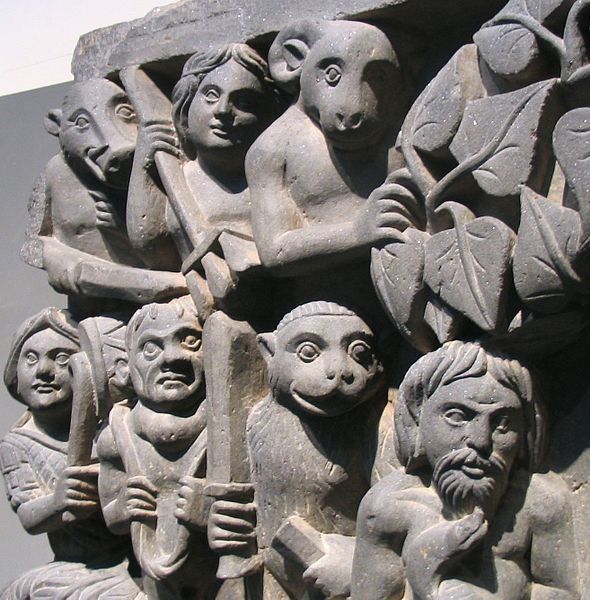
Next we saw examples of Buddhist art.  Our docent explained that up until the first century CE artists did NOT depict the Buddha.  Then, at that time, they began to depict him.  Here are outside links to a frieze depicting the Buddha's life:

http://www.arthist.umn.edu/aict/html/non_west/IND/IND009.html

http://upload.wikimedia.org/wikipedia/commons/thumb/e/ed/Four_Scenes_from_the_Life_of_the_Buddha_1.jpg/590px-Four_Scenes_from_the_Life_of_the_Buddha_1.jpg

The frieze was carved in Afghanistan, which is not surprising as Buddhism quickly became an international religion.  However, our docent noted that the sculptors of the frieze may have been Greek or Persian as their style was more Greek.  He then pointed out a figure wearing armor that seemed more appropriate to the Iliad than to the life of the Buddha. 

Here is a link from Ohio State about another frieze from India.  This page is quite informative.

http://kaladarshan.arts.ohio-state.edu/studypages/internal/dl/SouthAsia/Buddhist/pgs/u5/DL0209m.htm

We also looked at examples of Hindu art.  Unfortunately, we did not see any figures of Ganesh!  But here is an especially striking bronze of the god Shiva.  It is from the tenth century CE:

http://www.asia.si.edu/collections/singleObject.cfm?ObjectId=38637

This statue is a bronze of a devout queen as the goddess Parvati.  Our docent noted that a statue in a temple usually would have been garlanded and even clothed.
http://www.asia.si.edu/collections/singleObject.cfm?ObjectId=9849

Finally, here is a later statue of a child saint:

http://www.asia.si.edu/collections/singleObject.cfm?ObjectId=11802

We also saw some Japanese screens.  These were not on display, but the Freer owns some that depict scenes from The Tale of Genji:

http://www.asia.si.edu/collections/singleObject.cfm?ObjectId=39454


http://www.asia.si.edu/collections/singleObject.cfm?ObjectId=46858


http://www.asia.si.edu/collections/singleObject.cfm?ObjectId=46859

Below is a nineteenth-century scroll also depicting a scene from the novel:

http://www.asia.si.edu/collections/singleObject.cfm?ObjectId=28475


The Freer Gallery also contains the Peacock Room, which was designed by the influential artist James McNeill Whistler.  Did you know that he attended West Point for a year or so?

http://www.asia.si.edu/collections/singleObject.cfm?ObjectId=2122


Below are some of Whistler's works that we saw.  Note that they show the influence of Japanese art:

http://www.asia.si.edu/collections/singleObject.cfm?ObjectId=1924


http://www.asia.si.edu/collections/singleObject.cfm?ObjectId=151

To compare, here is a link to an 1859 work by American painter Frederic Edwin Church:

http://commons.wikimedia.org/wiki/Image:Church_Heart_of_the_Andes.jpg

This painting by Winslow Homer is from 1876, around the time that Whistler was working on "The Balcony" (see above):

http://commons.wikimedia.org/wiki/Image:Winslow_Homer_003.jpg

We concluded with a visit to an exhibit of Chinese paintings with literary themes:

http://www.asia.si.edu/exhibitions/current/talescont.htm

Hope you enjoyed this entry on our visit to the Freer Gallery!

Sunday, February 24, 2008

Southside by Dream City Theater Group (in progress)

The Washington DC area offers a wide variety of theater.  Just a couple of weeks ago my husband and I went to see international theater director Yukio Ninagawa's production of Shintoku-Maru at the Kennedy Center.  Last spring I saw a thrilling production of Richard III at the Shakespeare Theater near the Verizon Center.  The Gala Theater stages various productions, many of which are in Spanish.  (My husband and I saw Paul Flores and Julio Cardenas' two-man play, Representa! there.)  There are also the Synetic Theater's non-verbal performances grounded in Russian theatrical tradition.  (Someday I have to go out to Virginia where this company is based.)  Tonight we saw the Dream City Theater's staged reading of Southside, a play reworking the story of the 2004 Ballou shootings in which one young man killed a football star who was bullying him.  (The picture above is of Ballou Senior High where Thomas J. Boykin shot James Richardson.)

Unlike many of the theater companies in the area, the Dream City Theater is very local.  Its productions retell the stories of people living in Washington.  The first production of Dream City Theater's that I've seen was The 70, a play set on a Metrobus traveling from downtown Silver Spring down Georgia Avenue past Howard University and then Gallery Place and to the Southwest Waterfront.  Having lived in Silver Spring and spent much time near Gallery Place, I have often seen this bus.  Here is a little more about The 70:

http://www.dreamcitytg.org/projects/the70.htm    

This summer The 70 will be performed at the Atlas Performing Arts Center on H Street.  It will be interesting to see this play in a more final form. 

Here is more information about tonight's play, Southside:

http://www.dreamcitytg.org/projects/southside.htm

http://www.washingtonpost.com/wp-dyn/content/article/2008/02/14/AR2008021401125.html

Washington Post journalist Rachel Beckham interviews an actor from this play, Eddie B. Ellis.  He plays the role of a thirtyish prisoner who befriends Rondell, the young shooter.  Ellis served 15 years, many in super-max prisons, for manslaughter and now speaks to audiences about his experiences. 

http://www.washingtonpost.com/wp-dyn/content/article/2008/02/20/AR2008022002771.html

As the evening's performance was a staged reading, the actors read from their script, and there was some blocking but no props.  The individuals in a given scene would stand up at the front of the stage and read their lines while those not in that scene sat in a row of chairs at the back of the stage.  Actors wore street clothes although one actor playing a grandmother wrapped a sweater around herself as if it were a shawl. Several people played more than one part.  For the most part, this was not confusing.  One man played a scared security guard, a character based on former Mayor Anthony Williams, and a corrections officer.  He really was a ringer for the mayor, even without the bow tie! 

The play is not an exact retelling of the events in 2004.  The playwright, John Muller, has added a subplot about a young boy, Yummy, who sells loose candy to make money for his shiftless mother and his family and eventually takes money from a local thug ("Kojo") to shoot Rondell, the boy who shot Pee-Wee.  Yummy is based on a boy from Chicago who had committed 23 felonies and five misdemeanors before being killed himself to avenge a murder.  He became the subject of a Time cover story in 1994:  http://www.gregneri.com/Time_magazine.html  Here are links to stories about the 2004 shooting:  http://www.washingtonpos.com/wp-dyn/articles/A24158-2004Feb8.html
http://www.washingtonpos.com/wp-dyn/articles/A13630-2004Feb4.html
http://www.washingtonpost.com/wp-dyn/articles/A60982-2004Dec13.html

After the performance, the theater group held a question and answer session, beginning with questions directed to the playwright and moving on to those directed to the actors.  The topics of questions ranged from the playwright's writing process to the relationship between the play and the actual events in 2004 to the casting process to the lessons that the cast had learned from the experience of performing this play to future performances in the area where the play was set.  Again, this play is a work in progress, so the playwright was eager to find out what we thought. 

I will continue to keep an eye on Dream City Theater's work.

Saturday, February 9, 2008

Yukio Ninagawa's Shintoku-Maru at the Kennedy Center

Although we won't be starting the drama unit for a little while yet, I thought I'd post an entry about a play that my husband and I saw this evening...the Japanese play Shintoku-Maru, directed by Yukio Ninagawa.  The play was written during the 1970s, so it is a good example of more modern theater, especially in its reliance on spectacle and refusal to confine itself to realism.  The performance was entirely in Japanese, but the visuals and the acting were amazing.  The actors received two standing ovations, and, well, you can see some of the visuals from the picture above.

Shintoku-Maru tells the story of a young man who is alternately attracted to and repulsed by his stepmother, a woman his father has bought to "complete" the family.  In the meantime, Shintoku, the young man, has been searching for his dead mother, even in the underworld.  Therefore, his father's attempt to "complete" the family ends in madness, violence, and its dissolution.  This story reminds many of Oedipus Rex or Hippolytus. 

The play opened with a market scene.  Actors stood on a balcony above the rest of the stage, and sparks rained down from the torches that they held.  Again, you may see this from the picture above.  Other actors in various masks and disguises, often pushing carts, paraded back and forth on the stage.  Then Shintoku appeared, dressed in white Western clothing and holding a picture of his late mother.  Interestingly, he was the only character to wear pants.  Everyone else in his family (including his father) wore a patterned kimono.  And isn't white the color of mourning in Japanese culture?

In the next scene, Shintoku's father is looking over a display of actresses from a disbanded theater company.  One, Nadeshiko, will become his wife.  As played by Kayoko Shiraishi, this woman is very chatty and tries to become a part of her new family but is rejected by both her stepson *and* her husband.  (Her rejection by her husband is sexual.)  At first, she appears to be wearing a mask.  Here is a picture of Shintoku and Nadeshiko together at the end of the play:

 
  The actor playing Shintoku (Tatsuya Fujiwara) has appeared in a number of the director's productions, including a very torrid-looking Romeo and Juliet.  Here are some pictures from a 2001 or 2002 production of Shintoku-Maru in Japan:
http://www.majorleague.co.jp/kouen/shintokumaru/gallery/index.html

Truveo, a video site,  also has a link to an interview with Fujiwara about the making of Shintoku-Maru:

http://www.truveo.com/Fujiwara-Tatsuya-Making-of-Shintokumaru/id/3129579189

The scenes on this video are adult but not gratuitous.


For more about the director Yukio Ninagawa, here is a link to a 2001 interview with him:

http://www.guardian.co.uk/saturday_review/story/0,,493351,00.html

Often he has directed Shakespeare's plays:

http://www.telegraph.co.uk/arts/main.jhtml?xml=/arts/2006/06/10/bttitus10.xml


http://www.villagevoice.com/theater/0250,solomon,40440,11.html


http://www.yessirnigel.com/lear_pics.htm

I've been trying to find a link to articles about his production of Romeo and Juliet!

But I think that I will have to call it a night now.  Before I do, here is a link to an interview in which he swears off working with English-language actors:

http://www.ft.com/cms/s/2/ddd2052c-ecef-11db-9520-000b5df10621.html

His productions are not always critically well-received.  Critics Sheridan Morley and Michael Billington explain why:

http://www.iht.com/articles/1999/11/03/lon.t.php?page=1

http://www.guardian.co.uk/Archive/Article/0,4273,3922982,00.html

I wonder how Ninagawa's Lear compared to Kurosawa's Ran.