Showing posts with label worldliterature. Show all posts

Tuesday, July 6, 2010

Ngugi wa Thiong'o

The works of the Kenyan author Ngugi wa Thiong'o have intrigued me for a while because, for the past thirty-plus years, he has chosen to write them in Gikiyu, an African language, rather than in English.  Gikiyu being his first language, he believes that it is more appropriate for his writing and for African literature.  He views English as a colonizers' language that has been imposed on him.  (He and Chinua Achebe disagree on this.)  However, NwT is his own translator, which solves some of the problems of transmission.  (Note that Joseph Conrad, on the other hand, chose to write in English, rather than in Polish, and that he did not translate his own works into his first language.)

This article from the Global Literacy Project's web site discusses NwT's thoughts on the relationship between language and literature.

http://www.glpinc.org/Classroom%20Activities/Kenya%20Articles/Ngugi%20Wa%20Thiong%27o-On%20Language%20and%20Culture.htm

This article is more extensive and mentions his approach to each language:

http://www.nondomesticatedthinker.com/2010/04/dialogue-among-african-languages-by-ngugi-wa-thiong%E2%80%99o/

Here is a brief biography from 1996:

http://www.english.emory.edu/Bahri/Ngugi.html


This biography dates from 2001:
http://www.humanities.uci.edu/icwt/news/ngugi_bio.html

Since 2001, NwT has returned to Kenya where he and his wife suffered a vicious attack:
http://www.guardian.co.uk/books/2006/jan/28/featuresreviews.guardianreview13

Below are some maps that will help you place Kenya.


Below is a picture of a woman picking tea in Limuru, NwT's hometown.  I was surprised to see that it was less than twenty miles from Nairobi, Kenya's capital. 

This summer I was able to read NwT's novel, Petals of Blood.  This book is the last one he composed in English.  It is set in Ilmorog, a fictional Kenyan village that becomes a boomtown over the course of the novel.  Events take place during the late 1960s and early 1970s, after Kenya becomes independent.  Ostensibly, the story is something of a murder mystery as at the beginning, three wealthy men have been killed in a fire.  However, NwT's narrative focuses more on the paths that four friends take over the course of a dozen years.  These friends are Munira, a teacher from a wealthy family; Wanja, a businesswoman who becomes the madam of a brothel; Abdulla, Wanja's former partner; and Karega, a union organizer whom she once loved.  Each man is a suspect in the deaths of the three wealthy men, and each of the wealthy men was involved with Wanja.  (The fire occurred at her mansion.)  Interestingly, NwT finished up this novel in 1977 at a Soviet writers' colony.  (The USSR hadn't yet fallen.)


NwT's next novel, Devil on the Cross, is also set in Ilmorog.  This novel, on the other hand, was written in a Kenyan prison and is the author's first novel in Gikiyu.


I am also reading NwT's recent memoir, Dreams in a Time of War, which was published this year (2010).  It's always interesting to learn more about an author's background since he or she often draws on it for his/her fiction.  Unsurprisingly, NwT grew up in a village, and members of his working-class family were involved in 20th c. struggles against the British.  (Kenya was a British colony until 1963.)  His older brother, Good Wallace, belonged to the Mau Maus, a group that actively fought the British.  Like one of the minor characters in Petals of Blood, he was betrayed, but the ending of his story appears to be happier.  Like Joseph, Abdulla's adopted son, NwT won a scholarship to an elite high school in Kenya.  The memoir ends with his arrival at this school after some surprising twists and turns.


Tuesday, June 22, 2010

Werner Herzog's Fitzcarraldo


For a while, I've thought about showing Fitzcarraldo when I assign Heart of Darkness and Things Fall Apart.  Looks like this is the summer!

Like Heart of Darkness and Things Fall Apart, Fitzcarraldo is set during the age of imperialism--although it takes place in the early 20th century, rather than in the 19th century.  Unlike the two novels, Fitzcarraldo is...yes...a film, and it's a German film (although it was originally filmed in English).  The film's director is Werner Herzog, who now lives in Los Angeles but was originally based in Germany and is considered part of the New German Cinema. 

For more information about Herzog and his films, see these links.  With the second link, be sure to scroll down to see all of his films in alphabetical order:

http://www.imdb.com/name/nm0001348/bio
http://www.wernerherzog.com/films.html 

Fitzcarraldo came out in 1982, almost thirty years ago.  Therefore, it reflects a very different kind of film aesthetic from what you may be used to.  Herzog did not rely on CGI.  He filmed this movie in Peru, the boat (or boats...he used three different ones) were real, and the actors pulling the boat up the mountain and down again were real.  His shots are longer, and the camera tends to focus on scenes, giving actors time to react to what is going on.  Herzog was very proud that his film was *not* a Hollywood production...that he and his small crew sweated everything out, keeping the film going over a number of years and even cast changes.  When discussing his relationship with Klaus Kinski, the actor who plays Fitzcarraldo, Herzog relishes its turbulence and Kinski's frequent loss of control.  After all, he refers to this actor as his "Best Fiend."  (Below is a scene from the documentary, My Best Fiend.)


Back to the movie itself....it is set in the Amazon jungle--in Peru.


The filming was done in and around Iquitos, the largest city in the Amazon rainforest. The city's current population is 370,962.  Below are pictures of the city.  The first is from Wikipedia, and the second is from Explorations, Inc..  You might not be surprised to learn that Iquitos was a boom town during the early 1900s and that even now it is inaccessible except by airplane or boat.


Much of Fitzcarraldo is fiction or exaggeration although there was a Carlos Fitzcarrald as Dan James Pantone, Ph.D. points out in his article:
http://www.iquitosnews.com/page14a.html

Here are a few more scenes from Herzog's film.  First is a picture of Fitzcarraldo with his grammaphone in the jungle.


The next scene shows the boat in the jungle.  Once the boat had been pulled down the mountain, Herzog et al had quite a wild ride through the rapids.


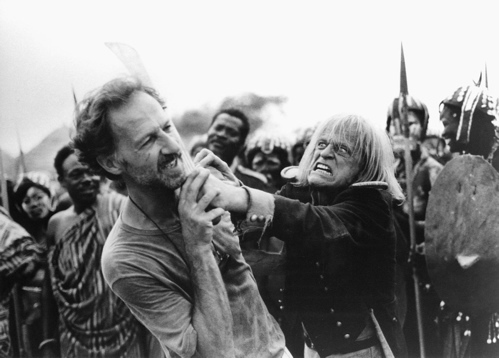
Below is a scene from the making of the film.  The man in the picture is director Herzog.


This scene takes place much earlier, before Fitzcarraldo goes out to find the boat and bring it down the mountain.  In this scene, he is still in Iquitos, and he is shouting out "I want my opera!!!"


Ironically, it is difficult to find pictures of the indigenous people in Fitzcarraldo although they are a strong presence in the movie itself.  Below is the best scene I can find:


I'll close with a picture of Fitzcarraldo with his partner Molly, a madam, as they sneak into the opera house where Enrico Caruso sings:

Or shall I close with a picture of Enrico Caruso himself?


And here are links to some of Caruso's recordings that are available on YouTube:

http://www.youtube.com/watch?v=aef9DGvZ8Qo

http://www.youtube.com/watch?v=OQt9x-GZQ8g&a=I8AVBv9Wn-M&playnext_from=ML

http://www.youtube.com/watch?v=hv5t7pOs4vc


http://www.youtube.com/watch?v=RL7wdUPXpiM

Clever Maids: The Secret History of the Grimm Fairy Tales


Americans have...or used to have...a saying that behind every successful man was a strong woman.  Valerie Paradiz' study is about the women who provided the Brothers Grimm with their stories and who, for the most part, did not receive any credit for it.  Ms. Paradiz argues that this occurred because of eighteenth and nineteenth century attitudes towards women.  Women were to be silent and submissive.  It goes without saying that they received limited educations. Indeed, the Brothers Grimm severely criticize their fifteen year old sister Lotte for mourning their mother's death and being unable to devote herself to domesticity the way that their mother had.  Wilhelm Grimm had a very problematic relationship with Annette von Droste-Hulshoff, a bright, feisty young woman who would later become a noted writer.  In fact,  von Droste-Hulshoff's picture appeared on a West German stamp in 1961.


However, the Brothers Grimm experienced other more supportive relationships with women.  I have mentioned their neighbor Dorothea Wild, who later married Wilhelm.  She was also Lotte's close friend and tried to mediate between her and her older brothers.  Here are links to two of the stories that Dorothea or Dortchen passed on to Wilhelm and Jacob.  The first is "The Six Swans," a story that Ms. Paradiz believes reflects Lotte's predicament:

http://www.pitt.edu/~dash/grimm049.html

Another was "The Singing Bone," a story that may have reflected Dortchen's own dilemma as the beloved of three of the Grimms: Wilhelm, Jacob, and Ferdinand, their ne'er do well sibling.

http://www.pitt.edu/~dash/type0780.html#grimm


Henry Justice Ford's 1894 illustration of "The Six Swans" is below:


Dortchen's sisters also contributed to the Grimms' project.  One of the first stories that they gave was "Child of Mary":
http://www.fairytalechannel.org/search/label/Child%20of%20Mary .  Dortchen's older sister Gretchen was the storyteller this time.  Another of Gretchen's contributions was "The Companionship of Cat and Mouse": 
http://www.cgjungpage.org/index2.php?option=com_content&do_pdf=1&id=156
Another sister, Mie, told the tale of "Godfather Death":
http://www.pitt.edu/~dash/grimm044.html .  However, I want to close with a link to another of Dortchen's stories, "All Fur":  http://www.pitt.edu/~dash/grimm065.html.  "Frau Holle" (pictured below) is another of her stories, too.

http://www.pitt.edu/~dash/grimm024.html

Another storyteller was Friederike Mannel, a pastor's daughter who ran a guest house in Allendorf.  She also contributed folk songs to a collection by Clemens Brentano, one of the Grimms' mentors.  One of her stories that she gave to the Grimms was "Fitcher's Bird."  The version printed here draws on her telling as well as on Dortchen's:

http://www.pitt.edu/~dash/grimm046.html


Allendorf is a common name for a German town or city, but I think that this may be Friederike Mannel's city:

Interestingly, as Ms. Paradiz relates, while Wilhelm enjoyed Friederike's company and respected her knowledge of folklore, he was highly annoyed by his mentor Brentano's young wife, Auguste, who had the temerity to discuss Shakespeare and Goethe.  Auguste was a fellow guest at Friederike's establishment.  Friederike was friendly to Auguste but also shared Wilhelm's annoyance with her.

The Grimms relied on other groups of sisters.  The first were the Hassenpflugs, a family who had emigrated from France because of religious persecution.  Ironically, the Hassenpflugs' stories brought French influences into the Grimms' collection of ostensibly German stories. Over the years, several of their stories were incorrectly attributed to "Old Marie," a fictional servant of the family.  This particularly strikes Ms. Paradiz as Marie Hassenpflug, one of the more prolific storytellers, was a beautiful young lady.  Marie's picture is below:


Among the sisters' contributions was "Little Red Cap":
http://www.pitt.edu/~dash/grimm026.html

Charles Perrault's "Little Red Riding Hood" may be found here: 
http://www.pitt.edu/~dash/type0333.html#perrault

Another contribution was "The Maiden with No Hands": 
http://www.surlalunefairytales.com/armlessmaiden/index.html

The second group of sisters were the von Hauxthausens, members of the German nobility and themselves collectors of German folklore.  Some of the stories that these women gave were written in dialect.  This particularly pleased the Grimms who were linguists as well as collectors of stories.  One story was "The Maid of Brakel" : 
http://www.readbookonline.net/readOnLine/4459/
Another, more famous, is "The Bremen Town Musicians" although the version given here is attributed to Dorothea Viehmann, another important storyteller and the only one who was given credit during the Grimms' lifetime.

http://www.pitt.edu/~dash/grimm027.html

"Devil Greencoat" was another story that the von Hauxthausens gave the Grimms.  Unfortunately, it is not available online, but you may reconstruct it from Surlalune's annotations:
http://www.surlalunefairytales.com/bearskin/notes.html

"Bearskin," a heavily revised version is available here: 
http://www.surlalunefairytales.com/bearskin/index.html

The youngest von Hauxthausen sister, ten year-old Anna, was particularly helpful to the Grimms.

Annette von Droste Hulshoff's sister Jenny was the source for "The Worn-out Dancing Shoes":
http://www.surlalunefairytales.com/twelvedancing/index.html
In 1874, Charles Deulin, a French author, reworked this story:
http://www.surlalunefairytales.com/twelvedancing/stories/lang.html
By the way, even though Annette terrified Wilhelm, he was very much attracted to Jenny, a sweeter and less opinionated young woman.  He may even have wished to marry her.


Finally, I'd like to mention Dorothea Viehmann, an older woman who more closely fit our preconceptions of the Grimms' sources.  Once middle class, she had married a tailor (an occupation that appears frequently in the Grimms' stories), and by the time she met Jacob and Wilhelm, she was quite poor, living a hand to mouth existence.  The stories that she provided included "The Goose Girl":
http://www.surlalunefairytales.com/goosegirl/index.html

"Doctor Know It All" :
http://www.pitt.edu/~dash/grimm098.html

and "The Three Army Surgeons":
http://www.pinkmonkey.com/dl/library1/story171.pdf

Unsurprisingly, not only did Dorothea Viehmann receive credit for telling the brothers her stories but her picture appeared in their collection.


Jack Zipes discusses the impact that historical and cultural context had on the Grimms' stories.  One wonders how much impact the storytellers' own lives had on the stories that they chose to give the brothers.

After Dorothea Viehmann's death in 1815, the Brothers Grimm moved on to a new stage of their careers.  Of course, many of their younger storytellers and collectors had also married and become mothers, so they no longer had time to provide the brothers with stories.  As Ms. Paradiz observes, from this point on, the stories that the brothers collected would be print versions from old libraries.  Wilhelm also spent much time adapting stories for young readers.  Even then, Ms. Paradiz notes, parents considered the Grimms' stories to be too harsh for their children.

I'll close with some images from the Grimms' stories.

This is actually an illustration of Hans Christian Andersen's retelling of "The Worn-Out Dancing Shoes":


Ah, this is a good place for a picture of a cat and a mouse!!

Here is a modern illustration of "Little Red Cap":

Once again here are the town musicians of Bremen .... in Bremen!


Monday, March 17, 2008

More on Brecht

  The picture above is from the recent production of Threepenny Opera (the most famous play by Brecht) with Cyndi Lauper and Nellie McKay.  Here is the video preview for that production--direct from You Tube:

http://www.youtube.com/watch?v=7A3CR5K8-ys


YouTube also has audio recordings of Lotte Lenya's versions of songs from the Threepenny Opera:

http://www.youtube.com/watch?v=jo7LpEkkAk0


http://www.youtube.com/watch?v=-V_iLXkx1Uo

Bertolt Brecht sings here:

http://www.youtube.com/watch?v=_QXJ3OXWaOY


Although I've posted this blog from the dramaturg of Villanova's production of Mother Courage, I think that it's worth reposting for the information about Brecht:

http://villanovatheatretalk.blogspot.com/2007_10_01_archive.html

I've posted this article on epic theater and Brecht's biography elsewhere as well, but I'm sure that you'll find it useful here:

http://www.cs.brandeis.edu/~jamesf/goodwoman/brecht_epic_theater.html

http://www.cs.brandeis.edu/~jamesf/goodwoman/brecht_bio.html

Deustche Welle, the German broadcasting service, has put together a picture gallery on Brecht and his work.  One picture is of Helene Weigel, his second wife and the most outstanding Mother Courage:

http://www.dw-world.de/popups/popup_imagegalerie/0,2172,2128266_page_1_lang_2,00.html


Here is a biography of Ms. Weigel.  Again, she is pictured as Mother Courage although she portrayed many other roles in her husband's plays.

http://www.artsalive.ca/en/thf/histoire/comediens.html#weigel

Brecht spent some time in the US while he was in exile from Germany.

http://www.dw-world.de/dw/article/0,2144,2125885,00.html

Here is an article about the Brecht-Weigel House in East Berlin.  It includes some information about Ms. Weigel's work after her husband's death when she led the Berliner Ensemble, the theater company that they had founded together.

http://www.socialsciences.manchester.ac.uk/chnn/CHNN17HOU.html

In 2001, a movie was made about a day in Brecht's life:

http://film.guardian.co.uk/interview/interviewpages/0,,531391,00.html

Let's finish with some articles on Brecht's influence on later theater.  The first is from Brandeis University's production of The Good Woman of Setzuan.

http://www.cs.brandeis.edu/~jamesf/goodwoman/brecht_influence.html

The next is from Deutsche Welle:

http://www.dw-world.de/dw/article/0,2144,2127719,00.html


Prof. Edward Isser of the College of the Holy Cross discusses Brechtian influence on the performance of Shakespeare!

http://www.holycross.edu/departments/theatre/eisser/BrechtianShakespeare.html


Sunday, February 24, 2008

Southside by Dream City Theater Group (in progress)

The Washington DC area offers a wide variety of theater.  Just a couple of weeks ago my husband and I went to see international theater director Yukio Ninagawa's production of Shintoku-Maru at the Kennedy Center.  Last spring I saw a thrilling production of Richard III at the Shakespeare Theater near the Verizon Center.  The Gala Theater stages various productions, many of which are in Spanish.  (My husband and I saw Paul Flores and Julio Cardenas' two-man play, Representa! there.)  There are also the Synetic Theater's non-verbal performances grounded in Russian theatrical tradition.  (Someday I have to go out to Virginia where this company is based.)  Tonight we saw the Dream City Theater's staged reading of Southside, a play reworking the story of the 2004 Ballou shootings in which one young man killed a football star who was bullying him.  (The picture above is of Ballou Senior High where Thomas J. Boykin shot James Richardson.)

Unlike many of the theater companies in the area, the Dream City Theater is very local.  Its productions retell the stories of people living in Washington.  The first production of Dream City Theater's that I've seen was The 70, a play set on a Metrobus traveling from downtown Silver Spring down Georgia Avenue past Howard University and then Gallery Place and to the Southwest Waterfront.  Having lived in Silver Spring and spent much time near Gallery Place, I have often seen this bus.  Here is a little more about The 70:

http://www.dreamcitytg.org/projects/the70.htm    

This summer The 70 will be performed at the Atlas Performing Arts Center on H Street.  It will be interesting to see this play in a more final form. 

Here is more information about tonight's play, Southside:

http://www.dreamcitytg.org/projects/southside.htm

http://www.washingtonpost.com/wp-dyn/content/article/2008/02/14/AR2008021401125.html

Washington Post journalist Rachel Beckham interviews an actor from this play, Eddie B. Ellis.  He plays the role of a thirtyish prisoner who befriends Rondell, the young shooter.  Ellis served 15 years, many in super-max prisons, for manslaughter and now speaks to audiences about his experiences. 

http://www.washingtonpost.com/wp-dyn/content/article/2008/02/20/AR2008022002771.html

As the evening's performance was a staged reading, the actors read from their script, and there was some blocking but no props.  The individuals in a given scene would stand up at the front of the stage and read their lines while those not in that scene sat in a row of chairs at the back of the stage.  Actors wore street clothes although one actor playing a grandmother wrapped a sweater around herself as if it were a shawl. Several people played more than one part.  For the most part, this was not confusing.  One man played a scared security guard, a character based on former Mayor Anthony Williams, and a corrections officer.  He really was a ringer for the mayor, even without the bow tie! 

The play is not an exact retelling of the events in 2004.  The playwright, John Muller, has added a subplot about a young boy, Yummy, who sells loose candy to make money for his shiftless mother and his family and eventually takes money from a local thug ("Kojo") to shoot Rondell, the boy who shot Pee-Wee.  Yummy is based on a boy from Chicago who had committed 23 felonies and five misdemeanors before being killed himself to avenge a murder.  He became the subject of a Time cover story in 1994:  http://www.gregneri.com/Time_magazine.html  Here are links to stories about the 2004 shooting:  http://www.washingtonpos.com/wp-dyn/articles/A24158-2004Feb8.html
http://www.washingtonpos.com/wp-dyn/articles/A13630-2004Feb4.html
http://www.washingtonpost.com/wp-dyn/articles/A60982-2004Dec13.html

After the performance, the theater group held a question and answer session, beginning with questions directed to the playwright and moving on to those directed to the actors.  The topics of questions ranged from the playwright's writing process to the relationship between the play and the actual events in 2004 to the casting process to the lessons that the cast had learned from the experience of performing this play to future performances in the area where the play was set.  Again, this play is a work in progress, so the playwright was eager to find out what we thought. 

I will continue to keep an eye on Dream City Theater's work.

Saturday, February 9, 2008

Yukio Ninagawa's Shintoku-Maru at the Kennedy Center

Although we won't be starting the drama unit for a little while yet, I thought I'd post an entry about a play that my husband and I saw this evening...the Japanese play Shintoku-Maru, directed by Yukio Ninagawa.  The play was written during the 1970s, so it is a good example of more modern theater, especially in its reliance on spectacle and refusal to confine itself to realism.  The performance was entirely in Japanese, but the visuals and the acting were amazing.  The actors received two standing ovations, and, well, you can see some of the visuals from the picture above.

Shintoku-Maru tells the story of a young man who is alternately attracted to and repulsed by his stepmother, a woman his father has bought to "complete" the family.  In the meantime, Shintoku, the young man, has been searching for his dead mother, even in the underworld.  Therefore, his father's attempt to "complete" the family ends in madness, violence, and its dissolution.  This story reminds many of Oedipus Rex or Hippolytus. 

The play opened with a market scene.  Actors stood on a balcony above the rest of the stage, and sparks rained down from the torches that they held.  Again, you may see this from the picture above.  Other actors in various masks and disguises, often pushing carts, paraded back and forth on the stage.  Then Shintoku appeared, dressed in white Western clothing and holding a picture of his late mother.  Interestingly, he was the only character to wear pants.  Everyone else in his family (including his father) wore a patterned kimono.  And isn't white the color of mourning in Japanese culture?

In the next scene, Shintoku's father is looking over a display of actresses from a disbanded theater company.  One, Nadeshiko, will become his wife.  As played by Kayoko Shiraishi, this woman is very chatty and tries to become a part of her new family but is rejected by both her stepson *and* her husband.  (Her rejection by her husband is sexual.)  At first, she appears to be wearing a mask.  Here is a picture of Shintoku and Nadeshiko together at the end of the play:

 
  The actor playing Shintoku (Tatsuya Fujiwara) has appeared in a number of the director's productions, including a very torrid-looking Romeo and Juliet.  Here are some pictures from a 2001 or 2002 production of Shintoku-Maru in Japan:

http://www.majorleague.co.jp/kouen/shintokumaru/gallery/index.html

Truveo, a video site,  also has a link to an interview with Fujiwara about the making of Shintoku-Maru:

http://www.truveo.com/Fujiwara-Tatsuya-Making-of-Shintokumaru/id/3129579189

The scenes on this video are adult but not gratuitous.


For more about the director Yukio Ninagawa, here is a link to a 2001 interview with him:

http://www.guardian.co.uk/saturday_review/story/0,,493351,00.html

Often he has directed Shakespeare's plays:

http://www.telegraph.co.uk/arts/main.jhtml?xml=/arts/2006/06/10/bttitus10.xml


http://www.villagevoice.com/theater/0250,solomon,40440,11.html


http://www.yessirnigel.com/lear_pics.htm

I've been trying to find a link to articles about his production of Romeo and Juliet!

But I think that I will have to call it a night now.  Before I do, here is a link to an interview in which he swears off working with English-language actors:

http://www.ft.com/cms/s/2/ddd2052c-ecef-11db-9520-000b5df10621.html

His productions are not always critically well-received.  Critics Sheridan Morley and Michael Billington explain why:

http://www.iht.com/articles/1999/11/03/lon.t.php?page=1

http://www.guardian.co.uk/Archive/Article/0,4273,3922982,00.html

I wonder how Ninagawa's Lear compared to Kurosawa's Ran. 

Sunday, February 3, 2008

The Rise of the Novel?

Above is an 18th-century illustration from Samuel Richardson's Clarissa, one of the novels that literary scholar Ian Watt considered among the origins of the genre. 

At some point, I am going to reread and review Watt's book, but for now here is a useful outline of histories of the novel from the University of Freiburg, a German university:

http://www.lit-arts.net/Behn/novel.htm

Here is a link to Ian Watt's obituary.  It will give you an idea of the importance he had in 20th century literary studies.

http://news-service.stanford.edu/news/2000/january5/watt-15.html


UC Berkeley Professor of Spanish American and Caribbean Literatures and Cultures Richard Rosa made this argument against Watt's history of the novel:

http://www.sobresites.com/alexcastro/artigos/whatisanovel.htm

FYAmuse, here is a link to the Google Books version of Daniel Defoe's Moll Flanders.  It is one of my favorite novels, and if I were editing our anthology of world literature, I would want to include an excerpt from it as well:

http://books.google.com/books?hl=en&id=RUxV6_7KX30C&dq=moll+flanders&printsec=frontcover&source=web&ots=JfV4uNzvvG&sig=gi2YvP4SNAT2WtJzPjsRk3XNXhw

I've linked elsewhere to Prof. Taormina's history of the novel, but I think that her page on 18th century novelists will give you an overview of that stage of the continuum.  Note that she is writing about the novel in English.

http://www.nvcc.edu/home/ataormina/novels/history/origins.htm

This page from the University of Missouri at Kansas City outlines the predecessors to the novel:

http://m.faculty.umkc.edu/mallinickd/romanticnovel/whipple/historya.html

Could Oroonoko be like the Italian and Spanish romances mentioned here?

I can't link to Catherine Gallagher's Nobody's Story here, but below is an essay by Ruth Nestvold about women and the history of the novel, beginning with Aphra Behn:

http://www.lit-arts.net/Behn/voice.htm

Thursday, January 31, 2008

Ge'ez and Its Literature (On African Civilizations pt. 1) Crossposting

While I'm on a roll this morning, I'd like to cross-post a site from my EN 201 blog.  It is on Ge'ez, a language that was once used in what is now Ethiopia and Eritrea.  I realize that Ethiopia is quite far from the Congo, but I also wanted to post an example of an entry derived from one honors student's annotated bibliography.

Ge'ez was used in Abyssinia, the ancestor of Ethiopia and Eritrea.  Now Amharic is the main language of Ethiopia, and Tigrigna is the main language of Eritrea, but both are descended from Ge'ez.  Now Ge'ez is mainly used within the Ethiopian and Eritrean monasteries, which explains my choice of picture above. 

Here is a link to information about the Debra Damo monastery.  It was built on a mountain in the sixth century CE, and it is accessible only to men who are willing to be climb up a rope ladder to the top of the mountain.

http://www.ethiopiantreasures.toucansurf.com/pages/damo.htm

Other monasteries are on islands off the Ethiopian coast:

http://news.bbc.co.uk/1/hi/world/africa/1560736.stm

A British man writes about what it is like to visit Ethiopia's churches and monasteries...and what it is like to climb up to Debra Damo!

http://blogs.bootsnall.com/vagabondrick/?p=231

But about Ge'ez....here is a site that gives the history of this language as well as examples of its alphabet:

http://www.ethiopianhistory.com/Ge'ez

This site compares Ge'ez with its "offspring":

http://www.omniglot.com/writing/ethiopic.htm


Could Ge'ez be close to the "Global World Language"?

http://www.valdostamuseum.org/hamsmith/Ogamlang.html


For more background on writings in Ge'ez, see these sites:

http://en.wikipedia.org/wiki/Ge'ez_language#History_and_literature

http://www.1911encyclopedia.org/Ethiopic_literature


http://wbelcher.bol.ucla.edu/

Here Prof. Getachew Haile, a professor of medieval studies at St. John's University in Minnesota and a political activist, discusses Ge'ez and Amharic with an interviewer:

http://www.senamirmir.com/interviews/theme/5-2001/gh/lang.html


Those of you who are mathematically-inclined may be interested in this writer's efforts to adapt the Amharic/Ge'ez numbering system to include a zero:

http://www.yebbo.com/j/index.php?option=com_content&task=view&id=447&Itemid=79

Abba Tesfamariam Baraki, a local pastor, is interviewed here:

http://www.youtube.com/watch?v=ZmuJTeSQaAg

Ancient African Civilizations & Ancient Greece & Rome (Cross-posting from EN 201)

After class today, I was thinking about all that Conrad did not know about Africa and its history--and all that we do know, so I thought that I'd post some sites on this topic, for your interest. I've also ordered some books on this topic, so if I get my act together, you may even see a new book review or two here!

Classics scholar Frank M. Snowden, Jr. began the serious study of the interactions between Africans and Egyptians, Greeks, & Romans. Among the pieces of evidence that he used was art from Ancient Egypt, Greece, and Rome. He argued that Africans did not experience prejudice from the Greeks and Romans and contributed to their civilizations.

http://www.neh.gov/news/humanities/2004-01/medals.html#snowden

Prof. Snowden spent much of his long career at Howard University. Here is a link to this university's exhibit honoring him for his accomplishments and his influence on classical studies. Here you'll be able to read excerpts from his books as well as reviews of these works:

http://www.howard.edu/library/Special/Excellence@Howard/Snowden/Blacks.htm

Here is the NY Times' recent obituary of Prof. Snowden:

http://www.nytimes.com/2007/02/28/obituaries/28snowden.html?ex=1330318800&en=36f6d8cfe26bf8d7&ei=5124&partner=permalink&exprod=permalink

For more information about the influence that Greek culture may have had on one African civilization, the Nubian civilization, see this link to Prof. Stanley Burstein's lecture at Howard:

http://www.chs.harvard.edu/publications.sec/online_print_books.ssp/frank_m._s...

Did you notice that Homer mentioned the Ethiopians in both of his epics?

In 1991, historian Martin Bernal argued that African civilizations strongly influenced the Ancient Greeks; his book was called Black Athena. This argument was criticized by Mary Lefkowitz, a professor of classics at Wellesley College, and other scholars, including Professor Snowden.

Here is a quick overview of the topic. Surprisingly, the discussion page on this entry is brief:

http://en.wikipedia.org/wiki/Black_Athena

For a variety of opinions, go to this web site:
http://www.worldagesarchive.com/Individual%20Web%20Pages/BlackAthena.html

Prof. Lefkowitz presents her critique of Bernal's argument here:

http://www.wellesley.edu/CS/Mary/contents.html

Prof. Bernal answers her at length here:
http://ccat.sas.upenn.edu/bmcr/1996/96.04.05.html

Friday, January 18, 2008

Reading Heart of Darkness

 It's always interesting (and fun) to look at the covers of different books.  Above is a cover of the 2002 edition by Hesperus Press, a British publisher. 

In the same year, Oxford University Press published an edition of Heart of Darkness (and other tales by Conrad) with this cover.  Its editor is Professor Cedric Watts of the University of Sussex.  My professor for the 18th & 19th century novel tended to prefer Oxford UP's editions. 

This edition is from Penguin and, as you might guess from the words in the orange border, dates from the turn of the century (20th to 21st).  Penguin has made available a plethora of great novels in relatively inexpensive and durable paperback.  The editor of this version is D.C.R.A. Goonetilleke, a professor from a university in Sri Lanka.

I like this image that appears to be a cover of an Ipod version.


Now I'd like to look for some older editions or possibly editions in other languages.

Now I've hit the jackpot!  Here is a picture of a cover from a Signet edition from the mid-20th century.  Unfortunately, the author of the web site where I found this picture did not include the date of the edition, but I would guess that this cover may be from the 1950s.  Although the picture appears to be aimed towards a more popular audience, the author of the introduction is Alfred J. Guerard, a noted scholar of Conrad's work and an early psychoanalytic critic.  Hmmm...things were different in the old days!


I'll close with an image of an English-language edition sold at Amazon Japan's site and an image of the edition that I used to own!  Honestly, the picture right above looks more like a painting by Constable (a British painter) than a picture of the Congo!

What do these covers have in common?  How are they different?  Do any seem like they might be influenced by Apocalypse Now?  Which may have been influenced by Nigerian novelist Chinua Achebe's reading of Conrad's novel? (See below for link.)

http://www.cis.vt.edu/modernworld/d/Achebe.html


Wednesday, June 13, 2007

The Novel (Cross-posting from EN 201)

Now that we are moving on from the epic to the novel, I thought that I'd put up an entry on this genre.

Here is a brief but limited overview of the novel from a professor at Northern Virginia Community College. Her site emphasizes the novel in English:

http://www.nvcc.edu/home/ataormina/novels/history/define.htm

http://www.nvcc.edu/home/ataormina/novels/history/origins.htm
http://www.nvcc.edu/home/ataormina/novels/structure/default.htm

For a more detailed and diverse introduction to the novel and the American novel, see this site from the University of North Carolina Pembroke:

http://www.uncp.edu/home/canada/work/markport/lit/amnovel/fall2002/01intro.htm

http://www.uncp.edu/home/canada/work/markport/lit/amnovel/fall2002/syllabus.htm

Do Journey to the West and Genji fit into these definitions? It's true that they are much older than the novels that both professors discuss. It's also true that if we go to the Classics department, we'll find that the novel existed in Greek and Roman literature.

http://ace.acadiau.ca/history/Provencal/Clas34232007.htm

http://people.uncw.edu/deagona/ancientnovel/bibliography.htm

http://people.uncw.edu/deagona/ancientnovel/mscott.htm

Here's a summary of one ancient novel, Heliodorus' Ethiopian Story, which was written in the third century BCE, during the Roman Empire.

http://www.chss.montclair.edu/classics/petron/heliodorus.html

But what about the Chinese novel? Here are some sites from Western and Asian writers alike:

http://nobelprize.org/nobel_prizes/literature/laureates/1938/buck-lecture.html

http://www.bopsecrets.org/rexroth/chinesenovels.htm

http://acc6.its.brooklyn.cuny.edu/~phalsall/texts/chinlit.html

http://chronicle.uchicago.edu/931209/roy.shtml

And is Genji a novel?
http://en.wikipedia.org/wiki/Talk:Japanese_literature
http://www.wsu.edu/~dee/ANCJAPAN/LIT.HTM
http://www.randomhouse.com/kvpa/smiley100/excerptsGenji.html
http://web-japan.org/kidsweb/explore/language/q1.html

On the other hand, even though the novel is defined as a *prose* narrative, here is some information about Vikram Seth's The Golden Gate, a recent novel in verse:

http://poetry.suite101.com/article.cfm/the_golden_gate
http://www.tetrameter.com/seth.htm