Showing posts with label film. Show all posts

Tuesday, August 2, 2011

Final Study Guide for EN 190 -- Summer II 2011

This study guide for the final will begin with F.W. Murnau's 1922 version of Nosferatu, an example of silent film and German Expressionism.  Below are links to YouTube versions of this film:

Here is a link to the YouTube video of the entire movie.  

http://www.youtube.com/watch?v=rcyzubFvBsA

This version has a better soundtrack:

http://www.youtube.com/watch?v=UDZURPwzkRg

Below is a picture of the actor Max Schreck who played Nosferatu.

Below is his brief biography.  More rumors than facts are known.


Here is a biography of director F.W. Murnau who later worked in Hollywood.  His picture is below.


Also, here is a link to my Multiply entry on the 1922 Nosferatu, the version that we saw.

http://worldlit2.multiply.com/journal/item/154/Nosferatu_1922

Werner Herzog remade this film in 1979:

http://worldlit2.multiply.com/journal/item/152/Nosferatu_1979

Let's move onto poetry.  As Jamaica Kincaid's "Girl" may be a poem or a short story, we may begin with her piece.  Here is some information about Ms. Kincaid:


Here is a little benna for you:


Below are the definitions of the short story and the poem that I included.

A short story is a brief prose work of narrative fiction characterized by a carefully crafted plot and style, complexity in characterization and point of view, and unity of effect.  It is shorter than a novel (50,000 or more words) or a novella (15,000 to 30,000 words).

A poem is a literary composition, written or oral, typically characterized by imagination, emotion, sense impressions, and
 concrete language that invites attention to its own physical features, such as sound or appearance on the page.

I will also include the prose poems we looked at before the midterm:


Monday we began the unit on poetry by looking at word and image.  Terms covered will include denotation, connotation, and sensory impression.  We will look at word choice in poems.  Monday's poems were Robert Hayden's "Those Winter Sundays" and Gwendolyn Brooks' "The Bean Eaters."  Note how short and condensed these poems were--and that Ms. Brooks' poem had rhyme.

Here is a link to the video of Robert Hayden's "Those Winter Sundays" that we listened to.  Note that we are *not* listening to Mr. Hayden's voice.


These links are to Gwendolyn Brooks' "The Bean Eaters":


For more information about Mr. Hayden, see this link:


For more information about Ms. Brooks, who was a very influential Chicago poet, see this link:


Sunday, August 15, 2010

Johann's "Happy-Go-Lucky" Trailer

Link

How does Poppy compare to Candide?

Thank you, Johann!

Monday, August 2, 2010

1923 Stan Laurel in Roughest Africa


Johann found the following link to a silent comedy with Stan Laurel

Link

The picture above is of Laurel and Hardy.  Here is a link to scenes from their comedies.  You may or may not like the soundtrack.

http://www.youtube.com/watch?v=HlDd9Cf1Zuw&feature=fvsr

This version is colorized!

http://www.youtube.com/watch?v=QI33gTIYX3s

Or you may prefer Charlie Chaplin....

http://www.youtube.com/watch?v=1mYtNMDFyXQ

http://www.youtube.com/watch?v=dDnAslIWDA4&feature=related


Here is a shot of Harold Lloyd:


Thursday, July 29, 2010

Raise the Red Lantern


Link


See the link above for an old entry on Raise the Red Lantern!

Also, here is a history of Chinese opera:

http://www.illuminatedlantern.com/cinema/archives/a_short_history_of_chinese_opera.php

This former student has an video of this type of opera posted at his Multiply site:

http://xxiaojoex.multiply.com/video/item/1/Chinese_Peking_Opera?replies_read=1


Tuesday, July 20, 2010

Theresita's Summary of Fitzcarraldo


Summary of Fitzcarraldo.
7/19/2010

The Movie Fitzcarraldo is a film directed and produced by a German filmmaker Werner Herzog.The story of an obsessed impresario whose foremost desire in life is to bring both Enrico Caruso and an opera house to the deepest jungles of South America.In order to raise the money for the opera house, Fitzcarraldo buys a broken down steamboat and plans to sail it up a tributary off the Amazon, pull the boat over a mountain and drop it into a neighboring tributary, so he can access the wealth of rubber trees there. To get there, though,he will have to brave raging rapids and tribes of hostile natives that are known to make shrunken heads out of foreign intruders.


Wednesday, July 14, 2010

Burden of Dreams


After watching the natives pulling the Molly-Aida up the mountain and down again, I really wanted to take another look at Les Blank's documentary about the making of Fitzcarraldo, Burden of Dreams.  If any film deserved its own documentary when it came out, Fitzcarraldo certainly did.  It was quite an undertaking.

Burden of Dreams is the source for a number of illuminating YouTube videos.  The first contains footage from the original Fitzcarraldo with Jason Robards and Mick Jagger.

http://www.youtube.com/watch?v=gTgDXu_Nhys

And, of course, it is the source of Herzog's remarks on the jungle, which I won't link to here.

But here is the trailer: 

http://www.youtube.com/watch?v=-PAsYkrEwjM&feature=channel_page


Below are links to reviews of Burden of Dreams.  One appears to be from 1982, when the film first appeared in theaters (and, in a shorter version, on PBS).

http://www.lesblank.com/art/BurdenDreams.html


The other is from 2000, so it has a little more perspective:

http://www.guardian.co.uk/film/2000/jan/13/derekmalcolmscenturyoffilm

The last is a 2003 article on Herzog.  It predates the revival of critical interest in his work--and the rise of the documentary!

http://www.theage.com.au/articles/2003/01/18/1042520819124.html


Monday, July 12, 2010

Nosferatu 1922!

<
This session we'll be headed back to where movies (about vampires) began...the German film director F.W. Murnau's Nosferatu, eine Symphonie des Grauens (1922) or Nosferatu: A Symphony of Horror.

This film is a silent film as movies did not have soundtracks until the late 1920s.  The first movie with sound was The Jazz Singer (1927) although it took a while for sound technology to be prevalent. 

http://www.imdb.com/title/tt0018037/trivia?tr0626469

Instead, a live musician (usually a pianist) or musicians accompanied the film.  For more information on the musicians and their music, see this article:

http://www.mont-alto.com/photoplaymusic.html


Cara Schreffler provides more information here:

http://www.markmusicproduction.com/blog.php?id=34

Even today there are silent film musicians.  Ben Model talks about the process of accompanying another film by Murnau:
http://www.youtube.com/watch?v=DT6jeBC1dSs&feature=related
Here you can listen to him playing:
http://www.youtube.com/watch?v=7Z6hgc6I4-s
Rosa Rio played from the silent film era to 2009:
http://www.youtube.com/watch?v=2_kZzmpAU8Q&feature=related

As you can see from the picture of Rosa Rio from the 1930s, movie theaters back then could be fairly elaborate.

Additionally, Nosferatu is an Expressionist film, rather than a realistic one.  Therefore, mood and imagery are especially important even if they don't seem terribly realistic.  I'm not sure that you may classify Nosferatu's colors as part of its expressionism.  Although movies included some color much earlier than I had thought, this technology was used fairly sparingly until after WWII.  See Adrienne Redd's article for more information about the use of color in film:

http://www.criticism.com/md/film2.html

I'd like to close with a few scenes from Murnau's film.


span class="insertedphoto">
It's interesting to note that almost all of the scenes I can find are of Max Schreck's Nosferatu!

Monday, July 5, 2010

Nosferatu 1979!


Vampires are incredibly popular now.  How many of you have seen the Twilight films or read the books that the films are based on?  How many of you know someone who is obsessed by the series?

Werner Herzog's Nosferatu is a very different kind of vampire film.  As you can see, Klaus Kinski's Nosferatu looks like an "old" man; he does not look like a teenager.  His victim, Lucy, is a young married woman, not a girl.  Also, as I mentioned in my entry on Herzog's Fitzcarraldo, Nosferatu came out in 1979, over thirty years ago.  Therefore, it reflects a very different kind of film aesthetic from what you may be used to.  Herzog did not rely on CGI, his film emphasizes image & atmosphere over plot, and his "takes" are longer than what you may be used to since the actor's reaction to situations and the buildup of atmosphere are very important in this type of film.  Also, in this particular film, there are a lot of long and extremely long shots, and in some of them, the actors are *not* facing the camera.  This is not to say that there is no plot or character in the movie.  Instead, Lucy takes a subtler approach to rescuing her husband.  She does not strap on an automatic weapon and start shooting garlic bulbs at the count...or whacking him over the head with a silver crucifix.

Below is a picture of the count's encounter with Lucy's husband, Jonathan Harker, a naive real estate agent.  At this point, the two men are in the count's castle in Transylvania.


Even before we see Count Dracula, we sense that we are in a different world.  (The film appears to be set during the 1800s, during the Romantic era when the Brothers Grimm were alive.)   Lucy's husband's journey to Count Dracula's castle is slower and more mysterious.  Lucy has premonitions of disaster--as she reveals to her husband in the scene below.

Here we see Lucy wandering throughout the city of Wisnau as she seeks to rescue her husband once he has returned from Count Dracula's castle.  Do you see the rats in the background?

The rats have arrived in the city with the count and his coffin-laden ship.  Naturally, all of the humans on the ship are dead...or undead.  By the way, officials in Delft, the Dutch city where Herzog began filming Nosferatu, forced him to stop because of the rats.  Perhaps there is something to be said for CGI.


Here are some links to information about Herzog's Nosferatu:

http://www.imdb.com/title/tt0079641/

http://rogerebert.suntimes.com/apps/pbcs.dll/article?AID=/19791005/REVIEWS/908319998/1023

The film is based on a 1920s silent film by Murnau, which was based on Bram Stoker's novel, Dracula.
http://filmsufi.blogspot.com/2008/10/nosferatu-werner-herzog-1979.html

http://www.kinoeye.org/02/20/chaffinquiray20.php


Tuesday, June 22, 2010

Werner Herzog's Fitzcarraldo


For a while, I've thought about showing Fitzcarraldo when I assign Heart of Darkness and Things Fall Apart.  Looks like this is the summer!

Like Heart of Darkness and Things Fall Apart, Fitzcarraldo is set during the age of imperialism--although it takes place in the early 20th century, rather than in the 19th century.  Unlike the two novels, Fitzcarraldo is...yes...a film, and it's a German film (although it was originally filmed in English).  The film's director is Werner Herzog, who now lives in Los Angeles but was originally based in Germany and is considered part of the New German Cinema. 

For more information about Herzog and his films, see these links.  With the second link, be sure to scroll down to see all of his films in alphabetical order:

http://www.imdb.com/name/nm0001348/bio
http://www.wernerherzog.com/films.html 

Fitzcarraldo came out in 1982, almost thirty years ago.  Therefore, it reflects a very different kind of film aesthetic from what you may be used to.  Herzog did not rely on CGI.  He filmed this movie in Peru, the boat (or boats...he used three different ones) were real, and the actors pulling the boat up the mountain and down again were real.  His shots are longer, and the camera tends to focus on scenes, giving actors time to react to what is going on.  Herzog was very proud that his film was *not* a Hollywood production...that he and his small crew sweated everything out, keeping the film going over a number of years and even cast changes.  When discussing his relationship with Klaus Kinski, the actor who plays Fitzcarraldo, Herzog relishes its turbulence and Kinski's frequent loss of control.  After all, he refers to this actor as his "Best Fiend."  (Below is a scene from the documentary, My Best Fiend.)


Back to the movie itself....it is set in the Amazon jungle--in Peru.


The filming was done in and around Iquitos, the largest city in the Amazon rainforest. The city's current population is 370,962.  Below are pictures of the city.  The first is from Wikipedia, and the second is from Explorations, Inc..  You might not be surprised to learn that Iquitos was a boom town during the early 1900s and that even now it is inaccessible except by airplane or boat.


Much of Fitzcarraldo is fiction or exaggeration although there was a Carlos Fitzcarrald as Dan James Pantone, Ph.D. points out in his article:
http://www.iquitosnews.com/page14a.html

Here are a few more scenes from Herzog's film.  First is a picture of Fitzcarraldo with his grammaphone in the jungle.


The next scene shows the boat in the jungle.  Once the boat had been pulled down the mountain, Herzog et al had quite a wild ride through the rapids.


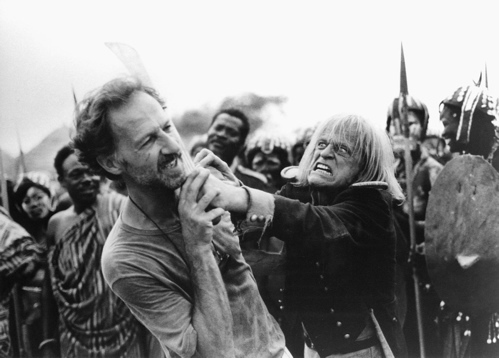
Below is a scene from the making of the film.  The man in the picture is director Herzog.


This scene takes place much earlier, before Fitzcarraldo goes out to find the boat and bring it down the mountain.  In this scene, he is still in Iquitos, and he is shouting out "I want my opera!!!"


Ironically, it is difficult to find pictures of the indigenous people in Fitzcarraldo although they are a strong presence in the movie itself.  Below is the best scene I can find:


I'll close with a picture of Fitzcarraldo with his partner Molly, a madam, as they sneak into the opera house where Enrico Caruso sings:

Or shall I close with a picture of Enrico Caruso himself?


And here are links to some of Caruso's recordings that are available on YouTube:

http://www.youtube.com/watch?v=aef9DGvZ8Qo

http://www.youtube.com/watch?v=OQt9x-GZQ8g&a=I8AVBv9Wn-M&playnext_from=ML

http://www.youtube.com/watch?v=hv5t7pOs4vc


http://www.youtube.com/watch?v=RL7wdUPXpiM

Friday, April 25, 2008

At last! The Final Prompts for EN 202 (Spring 2008)

[The picture above is from a 2007 production of The Country Wife, an intriguing Restoration comedy that hasn't been staged in this area for a while except (this weekend only) at American University!]

1.         Should professors continue to assign plays that are not available on film or are not being performed locally?   Why?  Why not?  Consider how planning for a performance of A Doll’s House, watching that performance, or going to Chesapeake Shakespeare’s performance of that play may have helped you understand Nora’s situation better.  Do you think that watching a performance of Mother Courage or The Love Suicides at Amijima might have helped you understand either play better?  Or should professors of literature not worry about what others choose to stage or film? After all, these professors are not professors of theater!  Feel free to discuss other plays that you’ve seen or to look at blog entries on Shintoku-Maru, Current Nobody, Southside, Gem of the Ocean, and (I hope!) Fences. 

 
2.  Discuss film as a genre of literature.  Given your definition of literature, how is film literature?  How is it NOT literature?  If you were to teach a film and literature course, which films would you include?  Why?  In this type of course, is it more important for a film to be a groundbreaking film (like Citizen Kane or Apocalypse Now) or for a film to be based on an important work of literature (like Jane Eyre, The Taming of the Shrew, or A Doll's House)?  Why?  How should you handle a film like Raise the Red Lantern or Ran that is not in English?  How would you handle a silent film like one of Charlie Chaplin’s or Oswald the Lucky Rabbit?


3.                  Discuss folk tales as a genre of literature.  How do stories like the Coyote Tales, Aesop’s Fables, or the tales that the Brothers Grimm collected fit into your ideas about literature?  How do they complicate your ideas?  Should our anthology have included stories about Rabbit, Raven, or Anansi the Spider?  Should our anthology have included additional stories about Coyote (“Coyote and Hen” or “Coyote’s Adventures in Idaho”) or “Godfather Death”?  How would a reworked story like Charles Perrault’s “Donkey Skin” or his “Cinderella” or Somerset Maugham’s “Appointment at Samarra” fit into your ideas about literature?  Conversely, compare one of our folk tales to an authored work like John Keats’ “The Eve of St. Agnes,” S.T. Coleridge’s “The Rime of the Ancient Mariner,” Ludwig Tieck’s “Fair-Haired Eckbert,” or the poems by Paula Gunn Allen and Leslie Marmon Silko.  How does the folk tale help you understand the authored work better?  How does the authored work help you understand the folk tale better?  Which does each type of work do better? 

4.  More of the works we’ve studied in the second half of the semester were originally written in a language other than English.  How does the presence of works NOT originally written in English (“Sarrasine,” Mother Courage, “Fair-Haired Eckbert”) or the Chinese-language film Raise the Red Lantern change your definition of world literature?  Or what about works like the Coyote Tales that were originally told in languages other than English?  Should EN 202 be a multilingual course?  (Feel free to bring in some of the works you read during the first part of the semester.)  Remember African authors Chinua Achebe and Ngugi wa Thiong’o’s essays on a writer’s choice of language.  Should Joseph Conrad should have written in Polish and relied on translators for his English or French audience?  Should the Native American writers Paula Gunn Allen, Leslie Marmon Silko, Cheryl Savageau, and Gerald Vizenor try to write in their tribe’s language?  Why?  Why not?


5.            Complete at least one of the following statements (apologies to Samuel Johnson):

            If (poem/poet/song/musician/rapper) be not poetry/a poet, what is poetry?

AND/OR

            If (poem/poet/song/musician/rapper) be poetry/a poet, what is poetry?


Support your argument with quotes from your poet, musician, or rapper as well as analysis of these quotes and your definition of what poetry is and what it is not.  Consider this statement by British poet Basil Bunting:  “Compose aloud.  Poetry is sound” as well as Robert Frost’s jab at free verse, Ezra Pound’s call to “make it new,” or the older statement from Samuel Johnson’s Rasselas that the poet is “not to number the streaks of the tulip.”  Consider the extent to which music relies on a singer’s voice and the producer’s arrangement and to which rap relies on a rapper’s persona and his/her authenticity.


Saturday, April 19, 2008

Study Guide for Final (Spring 2008) -- part 2 (film)

Before the midterm, we watched some films that were based on English-language novels.  These films included Apocalypse Now, the 1944 Jane Eyre starring Orson Welles, and the 1999 David Copperfield with a very young Daniel Radcliffe.  (Note: the version of David Copperfield that we saw was a TV miniseries and not intended for theatrical release.)  However, English-language novels are not the only literary sources that filmmakers draw on!

One could also adapt a play by Shakespeare as director Franco Zeffirelli and two other authors did with The Taming of the Shrew in 1967.  (Zeffirelli has also directed two direct adaptations of Shakespeare's plays: the 1968 Romeo and Juliet that you may have seen in high school as well as a 1990 Hamlet starring Mel Gibson as well as a 1996 theatrically-released version of Jane Eyre and film versions of various operas such as Otello and La Traviata.)  Although, as we saw, The Taming of the Shrew was filmed in the studio,  the set designer and the director did enough to counteract the staginess that older films based on plays often have.  Many scenes take place outdoors.  We first glimpse the "good" sister Bianca at a festival in the town square where students serenade her and lift up her veil.  Later on, Kate and her bridal party wait for Petruchio on the stairs into the cathedral, and the newly married couple are caught in the rain.  This film version contains a good deal of physical comedy as Petruchio pursues Kate, even on the rooftops, and they plunge into a bed of feathers.  As Kate, Elizabeth Taylor rolls her eyes and sticks her tongue out at Richard Burton's Petruchio.  Kate is introduced with a really intriguing shot as she looks out through a keyhole at her sister's would-be suitors.  Later on there is another shot where Bianca looks out through a keyhole.  I wish that we had been able to watch the scene where Kate gives her speech on a wife's duty.  How did Ms. Taylor perform that speech?!

EN 202 being a course in world literature, we also watched Chinese director Zhang Yimou's Raise the Red Lantern, a film from 1991, just two years after the events in Beijing's Tiananmen Square.  Raise the Red Lantern is  based on Su Tong's 1990 novella Wives and Concubines.  (I have just ordered this book from Amazon!) Zhang Yimou has also directed the historical films Red Sorghum and To Live as well as The House of Flying Daggers, a more action-oriented film.  In Raise the Red Lantern, university student Songlian (played by Gong Li) travels to northern China to become the fourth wife (or Fourth Mistress) of Chen.  She lives in a compound with Chen's other wives although each woman has her own house.  This compound is in the country, but we do not see much of the countryside, except in the very beginning of the film as Songlian walks to the compound.  The other wives are the older and psychologically distant First Mistress, mother of Chen's older son; Zhouyan, the second wife who appears to be very friendly and cheerful but is plotting against the others; and Meishan, a former opera singer who is the mother of Chen's younger son as well as the mistress of Doctor Gao.  Raise the Red Lantern takes place in the 1920s, a time of unrest throughout China although the Chinese Civil War did not begin until 1927.  The scene pictured above is of the lighting of the red lanterns, which signifies the house where Chen will spend the night.  In the film, it is a family tradition; therefore, Chen does not wish to question it.  Above Songlian is shown with her maid, Yan'er, who had had hopes of becoming the Fourth Mistress and, as we see, has hung red lanterns in her room.  (Or has Chen hung them there?)  After Songlian's ruse to feign pregnancy is discovered, and she betrays both Yan'er and Meishan, acts that result in their deaths, Songlian has a breakdown.  In the next to last scene, she is observed by Chen's new bride, the Fifth Mistress.

What did you make of the ending to Raise the Red Lantern?


Saturday, April 5, 2008

Eileen Chang & "Stale Mates"


I am going to have track down this book and/or movie, but in the meantime here is an entry on Chinese-American author Eileen Chang's work...which includes both "Stale Mates" and the novella "Lust, Caution."

To begin with, here is Ms. Chang's biography:

 http://www.hellomandarin.com/blog/2009/04/30/chinese-culture-eileen-changs-life-in-brief/

The author's literary executor has also written this essay that provides another perspective:

http://www.zonaeuropa.com/20050215_1.htm


This 2005 review of Ms. Chang's collected essays (in an English translation) provides more of a literary and cultural context for her work:

http://www.raintaxi.com/online/2005fall/chang.shtml

Irish writer John Self reviews the collection of fiction that contains "Lust, Caution."

http://theasylum.wordpress.com/2007/11/11/eileen-chang-lust-caution/


But about the film...

http://www.filminfocus.com/focus-movies/lust-caution/movie-splash.php


http://www.telegraph.co.uk/arts/main.jhtml?xml=/arts/2008/01/02/btchina102.xml

http://www.telegraph.co.uk/news/main.jhtml?xml=/news/2008/03/10/wlee110.xml

Another collection was Love in a Fallen City, which Haiyan Lee, a professor of Chinese literature at the University of Colorado, reviews here:

http://mclc.osu.edu/rc/pubs/reviews/lee.htm

Ms. Chang's first novel in English was The Rice-Sprout Song.  Charlie Dickinson reviews it here:

http://charlied.freeshell.org/RiceSproutSong

She also translated Chinese literature into English.  One novel was The Sing-Song Girls of Shanghai, which tells the story of nineteenth-century courtesans in that Chinese city.

http://cup.columbia.edu/book/978-0-231-12268-9/the-singsong-girls-of-shanghai

In addition, she wrote screenplays.  Australia's Queensland Art Gallery recently screened both the films that she had written screenplays for and those that others have made from her novels, novellas, and short stories:

http://apt5.asiapacifictriennial.com/cinema/hong_kong,_shanghai_cinema_cities/eileen_chang

At least one of these films may not have aged well (or have been that good to begin with):

http://www.brns.com/pages4/drama263.html


However, Eileen Chang's work in different media is very much worth exploring. 

Monday, February 18, 2008

Midterm Study Guide -- Spring 2008 -- part 2 (films!)

  Now let's have something more than this picture of Martin Sheen as Willard!

At this point, we've seen scenes from three films.  I am going to take out the copy of A Doll's House that the Rockville campus' library has, but I will include any information from that film on the study guide for drama/theater.

Apocalypse Now (1979) dir. Francis Ford Coppola (who also directed The Godfather--parts 1, 2, and 3).  According to Coppola at the time, "This isn't a film about Vietnam.  This is Vietnam."  The cast included Martin Sheen (Willard), Marlon Brando (Kurtz), Robert Duvall (Lt.Col. Kilgore, the officer with the cavalry hat), a very young Laurence Fishburne (Clean, one of the men on the boat), Albert Hall (Chief, the captain of the boat), Frederic Forrest (Chef, another of the men on the boat), Timothy Bottoms (Lance, the surfer on the boat), and Dennis Hopper (the photojournalist/a revision of the Russian in Heart of Darkness).

Jane Eyre (1944) dir. Robert Stevenson.  The novelist Aldous Huxley was among the screenwriters for this film.  In a number of scenes, Jane's narration appears as highlighted text in a book.  Some of this narration is not Bronte's novel but Huxley et al's screenplay.  Similarly, Dr. Rivers, the one adult who is kind to Jane, appears in the film but not in the book.  Joan Fontaine plays Jane as an adult; Peggy Anne Garner plays her as a child.  Orson Welles plays Mr. Rochester, her Byronic employer and later husband.  Margaret O'Brien plays Jane's pupil and Mr. Rochester's illegitimate daughter, Adele.   With this film's deep focus, it is hard to believe that it was filmed on a set and not at an actual castle.

David Copperfield (1999) -- This version of Dickens' novel (the closest thing we'll probably ever get to his autobiography) stars Daniel Radcliffe as the young David Copperfield.  We saw the following scenes: the evening that David is born to his widowed mother (his aunt Betsy Trotwood visits), David's term at a bad school (Ian McKellan plays the foul-tempered teacher), and his visit from Barkis (who will later marry David's nurse Peggotty) and Peggotty's nephew Ham.  At this bad school, David nevertheless meets Steerforth, a spoiled young man who becomes the boy's protector.

Which of these films would you include in a film and literature course?

Tuesday, February 12, 2008

Jane Eyre, David Copperfield, and Other Movies Based on 19th Century Novels

As we finish up our unit on novels and life writing, I thought that I'd show some movies based on canonical 19th century novels.  These movies will make for an interesting bridge between Harriet Jacobs' Incidents in the Life of a Slave Girl and Mariama Ba's So Long a Letter.

The picture above is from the 1944 Jane Eyre starring Joan Fontaine and Orson Welles.  The link below is to a review of the DVD of this movie.  I like that it focuses on both the book and the movie, putting both in context.  By the way, one of the screenwriters for this movie was Aldous Huxley, an important novelist in his own right.

http://www.dvdtown.com/reviews/jane-eyre/4599


Here is the IMDB page for this movie:

http://www.imdb.com/title/tt0036969/


Here British journalist Tanya Gold explains the appeal of Jane Eyre:
http://www.dailymail.co.uk/pages/live/femail/article.html?in_article_id=407404&in_page_id=1879
 The picture below is from the most recent version of Jane Eyre:

In 1996, Franco Zeffirelli directed a theatrically-released version of Jane Eyre starring Charlotte Gainsborough and William Hurt.

http://www.imdb.com/title/tt0116684/

Below is a poster from the 1999 version of David Copperfield that we will see in class.

Although this poster dates from the 1970s (it is colorized), it is a great picture of the 1935 version of David Copperfield with W.C. Fields as Mr. Micawber.
For more information about the novel David Copperfield, see this page by David A. Perdue:

http://charlesdickenspage.com/copperfield.html

PBS' site for the 1999 David Copperfield is here. 

http://www.pbs.org/wgbh/masterpiece/archive/programs/davidcopperfield/index.html

Interviews with the director and the screenwriter respectively are below:

http://www.pbs.org/wgbh/masterpiece/archive/programs/davidcopperfield/ei_curtis.html


http://www.pbs.org/wgbh/masterpiece/archive/programs/davidcopperfield/ei_hodges.html


If you are more visually oriented, you may enjoy this article:

http://www.pbs.org/wgbh/masterpiece/archive/programs/davidcopperfield/notes.html


Bleak House is my favorite novel by Dickens:

http://www.pbs.org/wgbh/masterpiece/bleakhouse/index.html

However, I mustn't neglect Emily Bronte's Wuthering Heights with Laurence Olivier and Merle Oberon (who hated each other):

Or the recent remake of Jane Austen's Pride and Prejudice:

But, as I've said in class, one often neglects the fact that people other than the British were writing novels and that movies were made of these novels.

See this link for Roger Ebert's review of Cousin Bette, a 1998 film based on one of Balzac's novels:  http://rogerebert.suntimes.com/apps/pbcs.dll/article?AID=/19980612/REVIEWS/806120303/1023

You may find Cousin Bette to be more interesting as it details a forty-something woman's revenge on her family and the man who refused to marry her:

This year Jacques Rivette directed an adaptation of Balzac's novella, The Duchess of Langaise.  However, it was not well-received, and it left the E Street Cinema pretty quickly.

http://www.observer.com/2008/balzac-book-goes-bust-big-screen-atrocities-africa

http://www.post-gazette.com/pg/08102/872313-42.stm

In 1993, French director Claude Berri made a movie based on Emile Zola's novel Germinal:

http://www.imdb.com/title/tt0107002/


I am surprised that I did *not* see this movie as one of my friends back in the day had liked Zola's novel.  The picture above is a scene from that movie. 

Every so often someone does a film version of Goethe's novel The Sorrows of Young Werther

http://www.the-sorrows-of-young-werther.com/index2.html

And then there is Tolstoy's War and Peace:

http://www.artdish.com/ubbcgi-bin/ultimatebb.cgi?ubb=get_topic&f=39&t=000327


http://thephoenix.com/article_ektid53137.aspx

Audrey Hepburn and Henry Fonda starred in a Hollywood version of War and Peace.