Showing posts with label german. Show all posts

Sunday, August 15, 2010

Wednesday, July 14, 2010

Burden of Dreams


After watching the natives pulling the Molly-Aida up the mountain and down again, I really wanted to take another look at Les Blank's documentary about the making of Fitzcarraldo, Burden of Dreams.  If any film deserved its own documentary when it came out, Fitzcarraldo certainly did.  It was quite an undertaking.

Burden of Dreams is the source for a number of illuminating YouTube videos.  The first contains footage from the original Fitzcarraldo with Jason Robards and Mick Jagger.

http://www.youtube.com/watch?v=gTgDXu_Nhys

And, of course, it is the source of Herzog's remarks on the jungle, which I won't link to here.

But here is the trailer: 

http://www.youtube.com/watch?v=-PAsYkrEwjM&feature=channel_page


Below are links to reviews of Burden of Dreams.  One appears to be from 1982, when the film first appeared in theaters (and, in a shorter version, on PBS).

http://www.lesblank.com/art/BurdenDreams.html


The other is from 2000, so it has a little more perspective:

http://www.guardian.co.uk/film/2000/jan/13/derekmalcolmscenturyoffilm

The last is a 2003 article on Herzog.  It predates the revival of critical interest in his work--and the rise of the documentary!

http://www.theage.com.au/articles/2003/01/18/1042520819124.html


Monday, July 12, 2010

Nosferatu 1922!

<
This session we'll be headed back to where movies (about vampires) began...the German film director F.W. Murnau's Nosferatu, eine Symphonie des Grauens (1922) or Nosferatu: A Symphony of Horror.

This film is a silent film as movies did not have soundtracks until the late 1920s.  The first movie with sound was The Jazz Singer (1927) although it took a while for sound technology to be prevalent. 

http://www.imdb.com/title/tt0018037/trivia?tr0626469

Instead, a live musician (usually a pianist) or musicians accompanied the film.  For more information on the musicians and their music, see this article:

http://www.mont-alto.com/photoplaymusic.html


Cara Schreffler provides more information here:

http://www.markmusicproduction.com/blog.php?id=34

Even today there are silent film musicians.  Ben Model talks about the process of accompanying another film by Murnau:
http://www.youtube.com/watch?v=DT6jeBC1dSs&feature=related
Here you can listen to him playing:
http://www.youtube.com/watch?v=7Z6hgc6I4-s
Rosa Rio played from the silent film era to 2009:
http://www.youtube.com/watch?v=2_kZzmpAU8Q&feature=related

As you can see from the picture of Rosa Rio from the 1930s, movie theaters back then could be fairly elaborate.

Additionally, Nosferatu is an Expressionist film, rather than a realistic one.  Therefore, mood and imagery are especially important even if they don't seem terribly realistic.  I'm not sure that you may classify Nosferatu's colors as part of its expressionism.  Although movies included some color much earlier than I had thought, this technology was used fairly sparingly until after WWII.  See Adrienne Redd's article for more information about the use of color in film:

http://www.criticism.com/md/film2.html

I'd like to close with a few scenes from Murnau's film.


span class="insertedphoto">
It's interesting to note that almost all of the scenes I can find are of Max Schreck's Nosferatu!

Monday, July 5, 2010

Nosferatu 1979!


Vampires are incredibly popular now.  How many of you have seen the Twilight films or read the books that the films are based on?  How many of you know someone who is obsessed by the series?

Werner Herzog's Nosferatu is a very different kind of vampire film.  As you can see, Klaus Kinski's Nosferatu looks like an "old" man; he does not look like a teenager.  His victim, Lucy, is a young married woman, not a girl.  Also, as I mentioned in my entry on Herzog's Fitzcarraldo, Nosferatu came out in 1979, over thirty years ago.  Therefore, it reflects a very different kind of film aesthetic from what you may be used to.  Herzog did not rely on CGI, his film emphasizes image & atmosphere over plot, and his "takes" are longer than what you may be used to since the actor's reaction to situations and the buildup of atmosphere are very important in this type of film.  Also, in this particular film, there are a lot of long and extremely long shots, and in some of them, the actors are *not* facing the camera.  This is not to say that there is no plot or character in the movie.  Instead, Lucy takes a subtler approach to rescuing her husband.  She does not strap on an automatic weapon and start shooting garlic bulbs at the count...or whacking him over the head with a silver crucifix.

Below is a picture of the count's encounter with Lucy's husband, Jonathan Harker, a naive real estate agent.  At this point, the two men are in the count's castle in Transylvania.


Even before we see Count Dracula, we sense that we are in a different world.  (The film appears to be set during the 1800s, during the Romantic era when the Brothers Grimm were alive.)   Lucy's husband's journey to Count Dracula's castle is slower and more mysterious.  Lucy has premonitions of disaster--as she reveals to her husband in the scene below.

Here we see Lucy wandering throughout the city of Wisnau as she seeks to rescue her husband once he has returned from Count Dracula's castle.  Do you see the rats in the background?

The rats have arrived in the city with the count and his coffin-laden ship.  Naturally, all of the humans on the ship are dead...or undead.  By the way, officials in Delft, the Dutch city where Herzog began filming Nosferatu, forced him to stop because of the rats.  Perhaps there is something to be said for CGI.


Here are some links to information about Herzog's Nosferatu:

http://www.imdb.com/title/tt0079641/

http://rogerebert.suntimes.com/apps/pbcs.dll/article?AID=/19791005/REVIEWS/908319998/1023

The film is based on a 1920s silent film by Murnau, which was based on Bram Stoker's novel, Dracula.
http://filmsufi.blogspot.com/2008/10/nosferatu-werner-herzog-1979.html

http://www.kinoeye.org/02/20/chaffinquiray20.php


Tuesday, June 22, 2010

Werner Herzog's Fitzcarraldo


For a while, I've thought about showing Fitzcarraldo when I assign Heart of Darkness and Things Fall Apart.  Looks like this is the summer!

Like Heart of Darkness and Things Fall Apart, Fitzcarraldo is set during the age of imperialism--although it takes place in the early 20th century, rather than in the 19th century.  Unlike the two novels, Fitzcarraldo is...yes...a film, and it's a German film (although it was originally filmed in English).  The film's director is Werner Herzog, who now lives in Los Angeles but was originally based in Germany and is considered part of the New German Cinema. 

For more information about Herzog and his films, see these links.  With the second link, be sure to scroll down to see all of his films in alphabetical order:

http://www.imdb.com/name/nm0001348/bio
http://www.wernerherzog.com/films.html 

Fitzcarraldo came out in 1982, almost thirty years ago.  Therefore, it reflects a very different kind of film aesthetic from what you may be used to.  Herzog did not rely on CGI.  He filmed this movie in Peru, the boat (or boats...he used three different ones) were real, and the actors pulling the boat up the mountain and down again were real.  His shots are longer, and the camera tends to focus on scenes, giving actors time to react to what is going on.  Herzog was very proud that his film was *not* a Hollywood production...that he and his small crew sweated everything out, keeping the film going over a number of years and even cast changes.  When discussing his relationship with Klaus Kinski, the actor who plays Fitzcarraldo, Herzog relishes its turbulence and Kinski's frequent loss of control.  After all, he refers to this actor as his "Best Fiend."  (Below is a scene from the documentary, My Best Fiend.)


Back to the movie itself....it is set in the Amazon jungle--in Peru.


The filming was done in and around Iquitos, the largest city in the Amazon rainforest. The city's current population is 370,962.  Below are pictures of the city.  The first is from Wikipedia, and the second is from Explorations, Inc..  You might not be surprised to learn that Iquitos was a boom town during the early 1900s and that even now it is inaccessible except by airplane or boat.


Much of Fitzcarraldo is fiction or exaggeration although there was a Carlos Fitzcarrald as Dan James Pantone, Ph.D. points out in his article:
http://www.iquitosnews.com/page14a.html

Here are a few more scenes from Herzog's film.  First is a picture of Fitzcarraldo with his grammaphone in the jungle.


The next scene shows the boat in the jungle.  Once the boat had been pulled down the mountain, Herzog et al had quite a wild ride through the rapids.


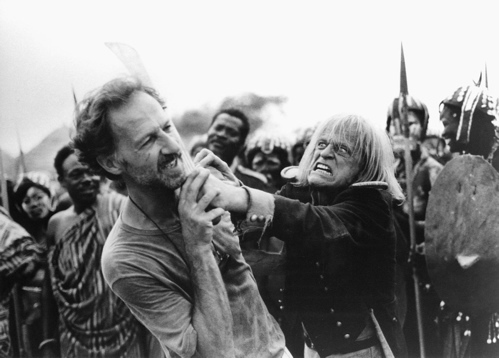
Below is a scene from the making of the film.  The man in the picture is director Herzog.


This scene takes place much earlier, before Fitzcarraldo goes out to find the boat and bring it down the mountain.  In this scene, he is still in Iquitos, and he is shouting out "I want my opera!!!"


Ironically, it is difficult to find pictures of the indigenous people in Fitzcarraldo although they are a strong presence in the movie itself.  Below is the best scene I can find:


I'll close with a picture of Fitzcarraldo with his partner Molly, a madam, as they sneak into the opera house where Enrico Caruso sings:

Or shall I close with a picture of Enrico Caruso himself?


And here are links to some of Caruso's recordings that are available on YouTube:

http://www.youtube.com/watch?v=aef9DGvZ8Qo

http://www.youtube.com/watch?v=OQt9x-GZQ8g&a=I8AVBv9Wn-M&playnext_from=ML

http://www.youtube.com/watch?v=hv5t7pOs4vc


http://www.youtube.com/watch?v=RL7wdUPXpiM

Clever Maids: The Secret History of the Grimm Fairy Tales


Americans have...or used to have...a saying that behind every successful man was a strong woman.  Valerie Paradiz' study is about the women who provided the Brothers Grimm with their stories and who, for the most part, did not receive any credit for it.  Ms. Paradiz argues that this occurred because of eighteenth and nineteenth century attitudes towards women.  Women were to be silent and submissive.  It goes without saying that they received limited educations. Indeed, the Brothers Grimm severely criticize their fifteen year old sister Lotte for mourning their mother's death and being unable to devote herself to domesticity the way that their mother had.  Wilhelm Grimm had a very problematic relationship with Annette von Droste-Hulshoff, a bright, feisty young woman who would later become a noted writer.  In fact,  von Droste-Hulshoff's picture appeared on a West German stamp in 1961.


However, the Brothers Grimm experienced other more supportive relationships with women.  I have mentioned their neighbor Dorothea Wild, who later married Wilhelm.  She was also Lotte's close friend and tried to mediate between her and her older brothers.  Here are links to two of the stories that Dorothea or Dortchen passed on to Wilhelm and Jacob.  The first is "The Six Swans," a story that Ms. Paradiz believes reflects Lotte's predicament:

http://www.pitt.edu/~dash/grimm049.html

Another was "The Singing Bone," a story that may have reflected Dortchen's own dilemma as the beloved of three of the Grimms: Wilhelm, Jacob, and Ferdinand, their ne'er do well sibling.

http://www.pitt.edu/~dash/type0780.html#grimm


Henry Justice Ford's 1894 illustration of "The Six Swans" is below:


Dortchen's sisters also contributed to the Grimms' project.  One of the first stories that they gave was "Child of Mary":
http://www.fairytalechannel.org/search/label/Child%20of%20Mary .  Dortchen's older sister Gretchen was the storyteller this time.  Another of Gretchen's contributions was "The Companionship of Cat and Mouse": 
http://www.cgjungpage.org/index2.php?option=com_content&do_pdf=1&id=156
Another sister, Mie, told the tale of "Godfather Death":
http://www.pitt.edu/~dash/grimm044.html .  However, I want to close with a link to another of Dortchen's stories, "All Fur":  http://www.pitt.edu/~dash/grimm065.html.  "Frau Holle" (pictured below) is another of her stories, too.

http://www.pitt.edu/~dash/grimm024.html

Another storyteller was Friederike Mannel, a pastor's daughter who ran a guest house in Allendorf.  She also contributed folk songs to a collection by Clemens Brentano, one of the Grimms' mentors.  One of her stories that she gave to the Grimms was "Fitcher's Bird."  The version printed here draws on her telling as well as on Dortchen's:

http://www.pitt.edu/~dash/grimm046.html


Allendorf is a common name for a German town or city, but I think that this may be Friederike Mannel's city:

Interestingly, as Ms. Paradiz relates, while Wilhelm enjoyed Friederike's company and respected her knowledge of folklore, he was highly annoyed by his mentor Brentano's young wife, Auguste, who had the temerity to discuss Shakespeare and Goethe.  Auguste was a fellow guest at Friederike's establishment.  Friederike was friendly to Auguste but also shared Wilhelm's annoyance with her.

The Grimms relied on other groups of sisters.  The first were the Hassenpflugs, a family who had emigrated from France because of religious persecution.  Ironically, the Hassenpflugs' stories brought French influences into the Grimms' collection of ostensibly German stories. Over the years, several of their stories were incorrectly attributed to "Old Marie," a fictional servant of the family.  This particularly strikes Ms. Paradiz as Marie Hassenpflug, one of the more prolific storytellers, was a beautiful young lady.  Marie's picture is below:


Among the sisters' contributions was "Little Red Cap":
http://www.pitt.edu/~dash/grimm026.html

Charles Perrault's "Little Red Riding Hood" may be found here: 
http://www.pitt.edu/~dash/type0333.html#perrault

Another contribution was "The Maiden with No Hands": 
http://www.surlalunefairytales.com/armlessmaiden/index.html

The second group of sisters were the von Hauxthausens, members of the German nobility and themselves collectors of German folklore.  Some of the stories that these women gave were written in dialect.  This particularly pleased the Grimms who were linguists as well as collectors of stories.  One story was "The Maid of Brakel" : 
http://www.readbookonline.net/readOnLine/4459/
Another, more famous, is "The Bremen Town Musicians" although the version given here is attributed to Dorothea Viehmann, another important storyteller and the only one who was given credit during the Grimms' lifetime.

http://www.pitt.edu/~dash/grimm027.html

"Devil Greencoat" was another story that the von Hauxthausens gave the Grimms.  Unfortunately, it is not available online, but you may reconstruct it from Surlalune's annotations:
http://www.surlalunefairytales.com/bearskin/notes.html

"Bearskin," a heavily revised version is available here: 
http://www.surlalunefairytales.com/bearskin/index.html

The youngest von Hauxthausen sister, ten year-old Anna, was particularly helpful to the Grimms.

Annette von Droste Hulshoff's sister Jenny was the source for "The Worn-out Dancing Shoes":
http://www.surlalunefairytales.com/twelvedancing/index.html
In 1874, Charles Deulin, a French author, reworked this story:
http://www.surlalunefairytales.com/twelvedancing/stories/lang.html
By the way, even though Annette terrified Wilhelm, he was very much attracted to Jenny, a sweeter and less opinionated young woman.  He may even have wished to marry her.


Finally, I'd like to mention Dorothea Viehmann, an older woman who more closely fit our preconceptions of the Grimms' sources.  Once middle class, she had married a tailor (an occupation that appears frequently in the Grimms' stories), and by the time she met Jacob and Wilhelm, she was quite poor, living a hand to mouth existence.  The stories that she provided included "The Goose Girl":
http://www.surlalunefairytales.com/goosegirl/index.html

"Doctor Know It All" :
http://www.pitt.edu/~dash/grimm098.html

and "The Three Army Surgeons":
http://www.pinkmonkey.com/dl/library1/story171.pdf

Unsurprisingly, not only did Dorothea Viehmann receive credit for telling the brothers her stories but her picture appeared in their collection.


Jack Zipes discusses the impact that historical and cultural context had on the Grimms' stories.  One wonders how much impact the storytellers' own lives had on the stories that they chose to give the brothers.

After Dorothea Viehmann's death in 1815, the Brothers Grimm moved on to a new stage of their careers.  Of course, many of their younger storytellers and collectors had also married and become mothers, so they no longer had time to provide the brothers with stories.  As Ms. Paradiz observes, from this point on, the stories that the brothers collected would be print versions from old libraries.  Wilhelm also spent much time adapting stories for young readers.  Even then, Ms. Paradiz notes, parents considered the Grimms' stories to be too harsh for their children.

I'll close with some images from the Grimms' stories.

This is actually an illustration of Hans Christian Andersen's retelling of "The Worn-Out Dancing Shoes":


Ah, this is a good place for a picture of a cat and a mouse!!

Here is a modern illustration of "Little Red Cap":

Once again here are the town musicians of Bremen .... in Bremen!


Sunday, June 20, 2010

The Brothers Grimm: From Enchanted Forests to the Modern World


This summer I resolved to learn a little more about fairy tales, specifically about the people who have written or transcribed them.  Probably the most famous of these people are the Brothers Grimm (Wilhelm and Jacob), so I've begun my reading with Prof. Jack Zipes' study (pictured above).  This book is more than a biography as it covers not only the brothers' life stories but also the impact that their tales have had on German readers (scholars & common readers)--and the reasons that they have had such an impact.

Do you know about the 2005 movie, The Brothers Grimm, that starred Heath Ledger?  (See the link below for the trailer:
http://www.youtube.com/watch?v=W3QkwDld1d4


    That is not the real story.

However, contrary to what we "know," neither did the Brothers Grimm go out to the farms and forests and collect stories from German peasants.  As Prof. Zipes points out, the brothers gathered their stories from literate, middle-class storytellers who came to their house.  (Wilhelm even married one of the storytellers, Dortchen Wild, a pharmacist's daughter.)  The brothers then collected different versions of these stories, revising and editing them for publication.  Wilhelm continued to rework these stories as the audience of the collections changed from adults to children.  Here is a link to a comparison of different versions of "Hansel and Gretel":
http://www.pitt.edu/~dash/grimm015a.html

You may also read different versions of "Snow White" here:
http://www.pitt.edu/~dash/grimm053.html
http://www.pitt.edu/~dash/type0709.html#snowwhite

Prof. Zipes therefore discusses the Grimms' tales as literary fairy tales, works that draw on both orality and print.  Although the Grimms' tales occupy a unique position in German and world culture, they are also very much a type of literature that was very popular in the 19th century.

Arthur Rackham's illustration below is from an English translation of "Snow White" (1909).  In this version, she is called Snowdrop.


Prof. Zipes also points out that the most well-known stories, the ones that we think of when we think about the Brothers Grimm's fairy tales, do not represent all of the stories that the brothers collected, revised, and edited.  Here are links to some other stories.  We may talk about "Godfather Death" in class: http://www.pitt.edu/~dash/grimm044.html.  Prof. Zipes discusses "The Maiden Without Hands" at length:  http://www.pitt.edu/~dash/grimm031.html  Another story that he alludes to is "Frau Trude" :  http://www.pitt.edu/~dash/grimm043.html

To see Justin Chen's art inspired by "The Maiden Without Hands," go to this link:
http://jkhc.blogspot.com/2009/02/maiden-without-hands-click-image-for.html

In fact, when we think about the most well-known stories, we may really be thinking about versions by Walt Disney or one of the many 20th-century writers for children!  

Prof. Zipes seems to be most interested in the historical and cultural context of the Grimms' stories.  Jacob and Wilhelm Grimm lived from 1785 to 1863 and 1786 to 1859.  During their lifetime, Germany was not one country.  It was divided up into different, independent states such as Hanover and Prussia, and, during the early 1800s, these states became satellites of France.  In other words, they were ruled by members of Napoleon's family.  As a result, the Grimms sought to preserve German culture and were very much in favor of German unification.  Their family situation complicated their political and cultural activism.  Since their father had died when they were boys, Jacob and Wilhelm also had to struggle to survive in a world where money and social standing were essential.  Both men trained as lawyers and worked in a variety of professions.  Yet ultimately they were successful.  They were able to pursue their cultural activism and publish a number of works, including the beginnings of a German dictionary as well as their anthologies of fairy tales.  The brothers were proud of their success and attributed it to their values (hard work, love of family, Protestant piety).  Prof. Zipes suggests that their stories reflected both the larger political and cultural context and the brothers' personal situation. 

Below is a map of Europe so that you may see where Germany is:


  Also, below is a picture of Kassel, the city that the Grimms called home.  It is now described as "the capital of the German fairy tale route":


Prof. Zipes concludes by showing how central the Grimms' tales are to Germans.  The stories are truly a common cultural currency and represent a different kind of popular culture, that is, folk culture.  As examples of folk culture, they played a key role in Germans' efforts to rehabilitate themselves after WWII and, in East Germany, to establish and support Communism. Late twentieth century authors in West Germany reworked these stories for adults and children both as satire and as stories that continued the Grimms' tradition of political and cultural activism.  Some of these reworkings are poems!  German pop psychology draws on the Grimms' tales in ways that intrigue yet infuriate Prof. Zipes.   He considers these pop psychologists' readings to be very limited and limiting.

It is always interesting to see how people from other cultures look at our readings...and at literature in general. 

Below is a picture of a sculpture of the Frog Prince.

And here is an image from a German comic "Frau mit Frosch" (Woman with Frog) about a businesswoman and her modern-day frog prince:

I tried to look for illustrations of some of the more outrageous modern-day adaptations, but they aren't online yet.  In more than one story, the fairy tale heroine starts a union for workers, and one even emigrates to America because our country has no kings or princes.  One hero is helped by an elf named Xram...Marx backwards.  And these were the adaptations from capitalistic West Germany!  The communist East Germans' adaptations were more traditional.