Did you know that you can stay at the Casa Fitzcarraldo the next time that you are in Iquitos, Peru? (The picture above is from this hotel's website. The daughter of Walter Saxer, Fitzcarraldo's executive producer, owns and operates this hotel.)
On to our study guide!
On our first day of class, we watched the following videos on the DR Congo, the current name for the setting of Conrad's novel:
Today we watched the following videos. The first is part one of Al Jazeera English's documentary on the DR Congo:
http://www.youtube.com/watch?
The next is the presentation on King Leopold II of Belgium:
http://www.youtube.com/watch?
I had intended to show the following video from Burden of Dreams, a film about the making of Fitzcarraldo:
http://www.youtube.com/watch?
On July 13 and 14, we watched Werner Herzog's Fitzcarraldo (1982) with Klaus Kinski in the title role, Claudia Cardinale as his partner Molly, the Brazilian actor Jose Lewgoy as the robber baron Don Aquilino, and Huerequeque Enrique Bohorquez, a non-actor, as Huerequeque the cook. Note that Herzog did *not* use CGI or models and that his actors pulled the boat up and down the mountain and into the river.
Here is the IMDB page for Fitzcarraldo:
http://www.imdb.com/title/tt0083946/
Roger Ebert's 1982 review is here:
http://rogerebert.suntimes.com/apps/pbcs.dll/article?AID=/19820101/REVIEWS/201010325/1023
Ebert revisited the movie in 2005:
http://rogerebert.suntimes.com/apps/pbcs.dll/article?AID=/20050828/REVIEWS08/508280301
On Wednesday we discussed the differences between novels and films as genres. Novels' characters have interiority, and we often get much more exposition and back story in a novel. We also talked about the roundness and flatness of characters. Films draw on visual and aural elements--but is a picture worth a thousand words?. They are collaborative (and commercial) whereas novels are more individual. (However, oddly enough, Jane Austen wrote all over her novels in her family's parlor and not in a private study.)
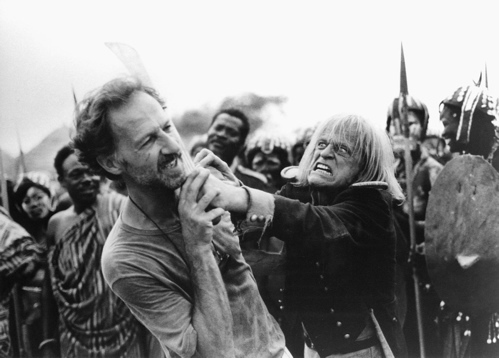
The picture below is Werner Herzog at work on Fitzcarraldo as his native actors look on. (How does Herzog depict these natives and their culture? How does Fitzcarraldo treat the natives?) Further below is a picture of the British author George Orwell at work alone.


On Thursday (7/15), we discussed Fitzcarraldo and the beginning of Heart of Darkness. We went over Joseph Campbell's monomyth ("The Hero's Journey") as it pertains to both Herzog's film and the beginning of Conrad's novel. See this link for the outline that we used:
http://orias.berkeley.edu/hero/JourneyStages.pdf However, there are more detailed outlines, so feel free to refer to them if you write about the hero's journey for your paper or the subjective exam. It is ironic that Campbell's monomyth applies to Fitzcarraldo almost as well as it applies to more commercial movies such as Star Wars or Mulan.
The picture below is from Joseph Campbell's The Power of Myth, his televised conversations with journalist Bill Moyers.

We also discussed the journey from the center to the margins. This journey is especially important in thinking about colonialist and post-colonialist writing. Note that, in Conrad's time, London was very much the center of empire whereas the Congo was quite marginalized. Does Fitzcarraldo make the same kind of journey from the center to the margins that Marlow does?
Also, Rudyard Kipling's "The White Man's Burden" will be on the midterm:
http://www.fordham.edu/halsall/mod/kipling.html
I didn't know that this poem was inspired by the Spanish-American War. This war heralded the U.S.' entry into imperialism as it took over several of Spain's colonies: the Phillippines, Cuba, and Puerto Rico, for example.
We also discussed the impact of historical context. Note that over eighty years separate Heart of Darkness and Fitzcarraldo. These more than eighty years include both World Wars, independence for a very many former colonies, and the Civil Rights movement. Then we can also look at cultural differences. Conrad was a former Russian subject who chose to become a British citizen. Herzog was born during WWII, grew up in West Germany, and now lives in Los Angeles (but is not an American citizen). One might also call him a citizen of the world as his work transcends the category of German or American cinema.
Note that Heart of Darkness has a frame narration. An unnamed Englishman narrates the frame story. In this story, his friend Marlow tells about his journey on the Congo River to rescue Kurtz, an agent for the Belgian company that Marlow once worked for. Can we trust the unnamed Englishman? Who is he? Can we trust Marlow?
Below is a picture from Apocalypse Now. Here Kurtz (played by Marlon Brando, the shaven-headed man) and Willard (Marlow's name in the film) are conversing.
On Monday (7/19), we continued our exploration of Heart of Darkness, using Joseph Campbell's monomyth, Chinua Achebe's "An Image of Africa," and Werner Herzog's comments on the jungle to help us get further.

How does Marlow's story follow the hero's journey? And, if it does, what is Marlow's elixir? How does it not follow the hero's journey? Is he a hero? Would Campbell consider him to be a hero? Or is he more of an anti-hero?
Below is Dr. Kenneth Wheeler's definition of an anti-hero:
ANTIHERO: A protagonist who is a non-hero or the antithesis of a traditional hero. While the traditional hero may be dashing, strong, brave, resourceful, or handsome, the antihero may be incompetent, unlucky, clumsy, dumb, ugly, or clownish. Examples here might include the senile protagonist of Cervantes' Don Quixote or the girlish knight Sir Thopas from Chaucer's "Sir Thopas." In the case of the Byronic and Miltonic antihero, the antihero is a romanticized but wicked character who defies authority, and becomes paradoxically ennobled by his peculiar rejection of virtue. In this sense, Milton presents Satan in Paradise Lost as an antihero in a sympathetic manner. The same is true of Heathcliffe in Emily Bronté's Wuthering Heights. Compare with the picaro {or "knave or rascal who is the protagonist in picaresque novels" or novels about a young man's misadventures}.
Below is Gustave Dore's illustration of Satan in Paradise Lost. Dore was active during the 19th century.

We also began to look at Marlow's depiction of women, beginning with his aunt (one of his helpers) and moving onto Kurtz' African mistress and his European fiancee. Why does Marlow depict these women (especially his aunt) the way he does? Why does he take pains to say that women are removed from the "world" and that they should not run things? Why does he lie to Kurtz' Intended (the fiancee) about her beloved's last words?
Here are some pictures of the New Woman (1890s/1900s). The first is from 1911 and was part of a paper published in ...Nineteenth Century Gender Studies. See the link below for the paper itself: http://ncgsjournal.com/issue32/roundtable.htm
The other pictures are earlier, dating from the 1890s. Although we take for granted women's ability to work outside the home and to exercise, these activities were once radical! Again, remember what I said about the corset, which physically deformed and confined women.


We then examined some passages from Heart of Darkness, using Achebe's essay and Herzog's comments to find the effects of racism and the jungle. Could Herzog's comments be in and of themselves racist or imperialist? How might Marlow's fireman look from another perspective? (The picture below is from Mother Jones and depicts Congolese "dandies.")

Note the effect that work has on both Marlow and his subordinates. (You may also want to see what he says about the Europeans and their attitude towards work.)
I'll conclude here with notes from Tuesday (7/20) since we finished up Heart of Darkness and we will be beginning Things Fall Apart on Wednesday (7/21).
At the beginning (or near beginning of class), Michelle gave her presentation on Sir Arthur Conan Doyle, author of the Sherlock Holmes stories (i.e., The Hound of the Baskervilles) *and* The Crime of the Congo, an expose of Belgian (mis)rule. Unlike Conrad, ACD was a very prolific, popular writer. As Michelle pointed out, he wrote not only the Sherlock Holmes stories but also science fiction, romances, and non-fiction. He trained as a physician and went to Africa as a ship's doctor, but he chose to write instead of practice medicine after his return to Great Britain. ACD wrote The Crime of the Congo in 1909 after both Rudyard Kipling and Joseph Conrad turned the assignment down. Not only did ACD write this book but he also publicized it, meeting with world leaders and lecturing on it to the public.
Below is his portrait from 1897.
 I will be posting Michelle's PowerPoint as soon as I am able to. In the meantime, here is a link to the site where The Crime of the Congo is posted.
http://www.kongo-kinshasa.de/dokumente/lekture/crime_of_congo.pdf
We finished up our discussion of Heart of Darkness. We explored whether or not Marlow had changed over the course of his story. Of course, one could also think about whether or not he had changed since the events of the story. Had he realized certain things as he brooded over what had happened in the Congo? We also looked at whether or not Kurtz had affected him and why his responses to him swung wildly. We briefly talked about Marlow's response to the young Russian's hero worship of Kurtz. (Later we saw Dennis Hopper's performance in Apocalypse Now.) We concluded by comparing Kurtz' mistress and his fiancee.


Then we watched the following clips from Apocalypse Now, Francis Ford Coppola's transformation of Conrad's novel about the Congo into a film about Vietnam...or one that was Vietnam.
Marlow's meeting with the Army brass follows:
http://www.youtube.com/watch?
Next is a link to Dennis Hopper's scenes. He plays an American photojournalist, and this person is Coppola's equivalent of Conrad's young Russian.
http://www.youtube.com/watch?
You may also want to look at these other scenes:
I like how Willard (Marlow's name in the film) states that he is waiting for a mission.
http://www.youtube.com/watch?
Here is a link to the infamous Ride of the Valkyries. Robert Duvall plays Kilgore, a colonel who is relatively unscathed by the war. Perhaps he is Coppola's equivalent of the Accountant.
http://www.youtube.com/watch?
These are scenes from the boat:
http://www.youtube.com/watch?
http://www.youtube.com/watch?
Finally, see this link for scenes with Marlon Brando's Kurtz:
http://www.youtube.com/watch?


 After watching the natives pulling the Molly-Aida up the mountain and down again, I really wanted to take another look at Les Blank's documentary about the making of Fitzcarraldo, Burden of Dreams. If any film deserved its own documentary when it came out, Fitzcarraldo certainly did. It was quite an undertaking.


 Below is a picture of the count's encounter with Lucy's husband, Jonathan Harker, a naive real estate agent. At this point, the two men are in the count's castle in Transylvania.
 Here we see Lucy wandering throughout the city of Wisnau as she seeks to rescue her husband once he has returned from Count Dracula's castle. Do you see the rats in the background?
 The rats have arrived in the city with the count and his coffin-laden ship. Naturally, all of the humans on the ship are dead...or undead. By the way, officials in Delft, the Dutch city where Herzog began filming Nosferatu, forced him to stop because of the rats. Perhaps there is something to be said for CGI.