Showing posts with label japan. Show all posts

Wednesday, August 20, 2008

Ono no Komachi

Link

I thought I'd add a link to an entry on the ninth-century Japanese poet, Ono no Komachi.  She is a wonderful, concise, and passionate poet who continues to intrigue the Japanese.

In the 19th century, the woodblock printer Ando Hiroshige and others depicted her in their work.

More recently playwrights have also depicted her.  Below is a scene from Aoi/Komachi, a performance of two of Yukio Mishima's plays.


Saturday, April 19, 2008

Study Guide for Final (Spring 2008) -- part 1 (drama)

This study guide for drama & theater will cover A Doll's House, Mother Courage, and The Love Suicides at Amijima.  The Taming of the Shrew will be included in our film unit.  The Japanese play Shintoku-Maru and August Wilson's Gem of the Ocean will not be included on the final--unless you'd like to mention them in the extra credit section! 

The picture above is from the now defunct Boston Shakespeare Company's 1984 production that starred the 4'9" actor Linda Hunt as Mother Courage.  One of my former professors has argued that Ms. Hunt's Mother Courage is among the best portrayals of that role (other than Helene Weigel's, of course!).  Below is an undated picture of Ms. Weigel in this role:


I've also highlighted the midterm study guide because that entry contains information about the difference between drama and theater *and* some historical background about A Doll's House.

To begin with...here is a review of A Doll's House, Henrik Ibsen's "problem play" from 1879.  It was originally written in Norwegian although it was soon translated into other languages including English.  At the time it was first performed, A Doll's House was controversial, especially because of its ending!  The play is set at Christmastime in Norway (Oslo?).  The characters are Nora Helmer, a youngish woman whom no one takes seriously; her husband, Torvald, a lawyer who has finally been hired to manage the National Bank; Krogstad, a bank employee who has lent Nora money and whom Torvald is about to fire; Mrs. Linde, Nora's school friend who is about to be hired by Torvald; and Doctor Rank, a dying friend of the family who confesses his love for Nora.  Nora and Torvald have three children.  Nora borrowed money so that Torvald (who was then ill) could travel to Italy's warmer climate.  However, as Torvald refused to borrow money, she forged her dying father's signature so that she could borrow money from Krogstad.  (In the 19th century, a woman could not borrow money on her own; furthermore, very much unlike today, her husband was generally awarded custody of their children--if their marriage dissolved.)  The play begins as Krogstad threatens to blackmail Nora.

The 20th century German playwright Bertolt Brecht's work can be considered in opposition to the previous generation's plays (like A Doll's House) that are well-made, are very much suited to the proscenium stage with its fourth wall, and have consistent characters with back stories and motivation that we can discuss.  (Note that Ibsen's advocates in English included the failed playwright and ground-breaking novelist Henry James.)  On the other hand, Mother Courage takes place over twelve years (1624 to 1636) as Anna Fierling (aka Mother Courage) tries to hold her family together and profit from the war, selling food, drink, clothes, and ammunition to both sides.  At one point, as the Catholics overcome the Protestant forces, Mother Courage, her family, and their hangers-on change religions.  Mother Courage's family is made up of Eilif, who joins the Protestant army despite her protests; Swiss Cheese, who is killed while his mother haggles over the means to pay a bribe; and Katrin, the mute daughter who is raped and later sacrifices herself to warn villagers of an approaching army.  The hangers-on include Mother Courage's two suitors, a Protestant chaplain and a cook (who tries to convince her to abandon war profiteering and help him run a tavern in Utrecht, away from the battlefield), and Yvette, a prostitute whose red shoes are stolen by Katrin.  Mother Courage and Her Children (the full name of the play) was written in 1939 when the playwright was in exile from Nazi Germany.  (Brecht was a Communist and known for his politicized theater.) 
Ideally, the audience is discouraged from sympathizing with Mother Courage and the other characters, and actors are expected to be critical observers of their characters' actions.  Practically, this approach may have made this play difficult to stage although this is probably not the only factor.  Other plays by Brecht include The Threepenny Opera and The Good Woman of Setzuan.  As in The Threepenny Opera, the characters of Mother Courage (except for Katrin, of course) often break into songs intended to comment on the play's action.  Can you imagine Nora and Torvald breaking into song like that?!  OTOH, as I mentioned in class, an actor who has done well with roles like Chicago's Mama Morton, Velma, or Roxie probably could do well with the role of Mother Courage!

With the unit's final play, The Love Suicides at Amijima, we move back in time to 1720 and to a very different theater.  The playwright Chikamatzu Monzaemon wrote this play for the bunraku theater, a Japanese theater that relies on puppets and a chanting narrator.  However, as has been noted, the play was also performed in the kabuki theater by human (male) actors.  From 1629 until very recently, women were not allowed to act in kabuki.  The Love Suicides at Amijima tells the story of Koharu, a young prostitute, and her lover Jihei, a married man, youngish father, and struggling paper merchant.  Because they cannot be together, the lovers commit suicide at a Buddhist temple.  Jihei's wife (and cousin) Osan is surprisingly accepting of her husband's involvement with Koharu, but her family tries to break up the love affair.  At one point, Jihei's brother disguises himself as a samurai and pretends to be Koharu's customer. 

Here is a picture of The Love Suicides at Amijima

  The picture below is a close-up of bunraku, a puppet theater for which The Love Suicides at Amijira was originally written:
  Below is a picture of images from Kabuki theater:


Thursday, April 3, 2008

Our Visit to the Freer Gallery (March 29)

  Now that I have a little bit of time this morning, I'd like to post a quick entry on last Saturday's trip to the Freer Gallery and, of course, thank those of you who were able to venture out to the city on a Saturday, a very crowded Saturday!  For those of you who weren't able to venture out, fortunately, most of what we saw was from the permanent collection, so it's likely that you'll be able to see some of what we saw on our trip.

On the other hand, we did have a docent who gave us a tour.  I highly recommend it as he had visited many of the countries whose art we saw and he was able to slow us down!  Speaking from experience, I've found that it is easier and easier to dash through a museum and see nothing.   More importantly, though, the docent emphasized sculpture and illuminated manuscripts, types of art that I am usually not drawn to but that are important to an understanding of Asian culture.  So, here is a link to the Freer and Sackler Galleries' information about their tours.

http://www.asia.si.edu/visitor/tours.htm

Again, I highly recommend going on one of these tours, especially if you are new to museumgoing, but also if you are experienced.

But back to our tour...we began by examining an enormous guardian figure from a Japanese temple.  The docent explained that at one point the figure had been painted but that over the years the paint had worn away.  He also informed us that the figure had been made in parts.  Then he showed us that the figure's arms were mismatched.  Unfortunately, the Freer does not have a picture of this particular figure, but here is a link to a picture of a similar figure and information about it:

http://www.asia.si.edu/collections/singleObject.cfm?ObjectId=11859


Next we moved on to an exhibit on Islamic art where we saw a mihrab, a panel that would have indicated the direction of Mecca to worshippers in a mosque.  Here is a link to the picture of the mihrab.

http://www.asia.si.edu/collections/singleObject.cfm?ObjectId=4811

We also looked at pages from the Koran, some dating from the ninth century CE!  The docent explained to us how Arabic script had changed over the years.  Here is an example of one of the earliest manuscripts.  It is written in kufic script, a style that looks very different from modern script!

http://www.asia.si.edu/collections/singleObject.cfm?ObjectId=9837

To preserve these manuscripts, the museum severely limits the period of time that they are on display.  A manuscript may be shown for only a month at a time!  In turn, this means that there is always something new and different to look at in this gallery.

We also saw metalwork bowls, one of which combined Christian and Islamic imagery.  This link below is not to this bowl, but it is to a tile that draws on Jewish imagery (the Star of David):

http://www.asia.si.edu/collections/singleObject.cfm?ObjectId=1944

Next we saw examples of Buddhist art.  Our docent explained that up until the first century CE artists did NOT depict the Buddha.  Then, at that time, they began to depict him.  Here are outside links to a frieze depicting the Buddha's life:

http://www.arthist.umn.edu/aict/html/non_west/IND/IND009.html

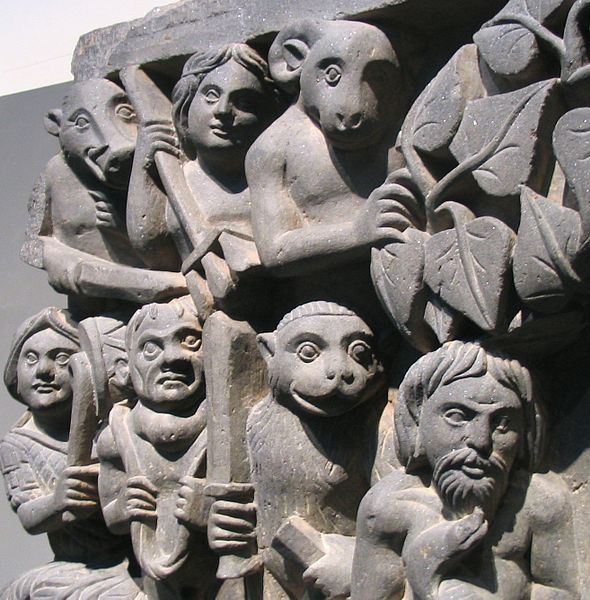
http://upload.wikimedia.org/wikipedia/commons/thumb/e/ed/Four_Scenes_from_the_Life_of_the_Buddha_1.jpg/590px-Four_Scenes_from_the_Life_of_the_Buddha_1.jpg

The frieze was carved in Afghanistan, which is not surprising as Buddhism quickly became an international religion.  However, our docent noted that the sculptors of the frieze may have been Greek or Persian as their style was more Greek.  He then pointed out a figure wearing armor that seemed more appropriate to the Iliad than to the life of the Buddha. 

Here is a link from Ohio State about another frieze from India.  This page is quite informative.

http://kaladarshan.arts.ohio-state.edu/studypages/internal/dl/SouthAsia/Buddhist/pgs/u5/DL0209m.htm

We also looked at examples of Hindu art.  Unfortunately, we did not see any figures of Ganesh!  But here is an especially striking bronze of the god Shiva.  It is from the tenth century CE:

http://www.asia.si.edu/collections/singleObject.cfm?ObjectId=38637

This statue is a bronze of a devout queen as the goddess Parvati.  Our docent noted that a statue in a temple usually would have been garlanded and even clothed.
http://www.asia.si.edu/collections/singleObject.cfm?ObjectId=9849

Finally, here is a later statue of a child saint:

http://www.asia.si.edu/collections/singleObject.cfm?ObjectId=11802

We also saw some Japanese screens.  These were not on display, but the Freer owns some that depict scenes from The Tale of Genji:

http://www.asia.si.edu/collections/singleObject.cfm?ObjectId=39454


http://www.asia.si.edu/collections/singleObject.cfm?ObjectId=46858


http://www.asia.si.edu/collections/singleObject.cfm?ObjectId=46859

Below is a nineteenth-century scroll also depicting a scene from the novel:

http://www.asia.si.edu/collections/singleObject.cfm?ObjectId=28475


The Freer Gallery also contains the Peacock Room, which was designed by the influential artist James McNeill Whistler.  Did you know that he attended West Point for a year or so?

http://www.asia.si.edu/collections/singleObject.cfm?ObjectId=2122


Below are some of Whistler's works that we saw.  Note that they show the influence of Japanese art:

http://www.asia.si.edu/collections/singleObject.cfm?ObjectId=1924


http://www.asia.si.edu/collections/singleObject.cfm?ObjectId=151

To compare, here is a link to an 1859 work by American painter Frederic Edwin Church:

http://commons.wikimedia.org/wiki/Image:Church_Heart_of_the_Andes.jpg

This painting by Winslow Homer is from 1876, around the time that Whistler was working on "The Balcony" (see above):

http://commons.wikimedia.org/wiki/Image:Winslow_Homer_003.jpg

We concluded with a visit to an exhibit of Chinese paintings with literary themes:

http://www.asia.si.edu/exhibitions/current/talescont.htm

Hope you enjoyed this entry on our visit to the Freer Gallery!

Wednesday, March 26, 2008

The Love Suicides at Amijima

I should be grading my papers from EN 101A, and in class we are moving on beyond drama to...film, but I thought that I would post a quick blog entry on the play that we have just read, The Love Suicides at Amijima.  The picture above is from a 1997 English-language version performed at NYC's LaMama Theater.  For more information about this production, see this link below:

http://www.theatrejapan.com/amijima.html

A professor at Washburn University in Kansas has posted background on the play. 

http://www.washburn.edu/reference/bridge24/Chickamatsu.html

For more information about bunraku (the genre that this play originally belonged to):

http://www.japan-zone.com/culture/bunraku.shtml

http://www.sagecraft.com/puppetry/definitions/Bunraku.hist.html

http://www.puppetcentre.org.uk/animationsonline/aotwentyone/ao21_whatsinaname.html

Here are video clips of bunraku although not of Love Suicides:

http://www2.ntj.jac.go.jp/unesco/bunraku/en/video.html

In 1969, a film version of Love Suicides (Double Suicide) appeared:

http://www.gotterdammerung.org/film/shinoda-masahiro/double-suicide.html


Saturday, February 9, 2008

Yukio Ninagawa's Shintoku-Maru at the Kennedy Center

Although we won't be starting the drama unit for a little while yet, I thought I'd post an entry about a play that my husband and I saw this evening...the Japanese play Shintoku-Maru, directed by Yukio Ninagawa.  The play was written during the 1970s, so it is a good example of more modern theater, especially in its reliance on spectacle and refusal to confine itself to realism.  The performance was entirely in Japanese, but the visuals and the acting were amazing.  The actors received two standing ovations, and, well, you can see some of the visuals from the picture above.

Shintoku-Maru tells the story of a young man who is alternately attracted to and repulsed by his stepmother, a woman his father has bought to "complete" the family.  In the meantime, Shintoku, the young man, has been searching for his dead mother, even in the underworld.  Therefore, his father's attempt to "complete" the family ends in madness, violence, and its dissolution.  This story reminds many of Oedipus Rex or Hippolytus. 

The play opened with a market scene.  Actors stood on a balcony above the rest of the stage, and sparks rained down from the torches that they held.  Again, you may see this from the picture above.  Other actors in various masks and disguises, often pushing carts, paraded back and forth on the stage.  Then Shintoku appeared, dressed in white Western clothing and holding a picture of his late mother.  Interestingly, he was the only character to wear pants.  Everyone else in his family (including his father) wore a patterned kimono.  And isn't white the color of mourning in Japanese culture?

In the next scene, Shintoku's father is looking over a display of actresses from a disbanded theater company.  One, Nadeshiko, will become his wife.  As played by Kayoko Shiraishi, this woman is very chatty and tries to become a part of her new family but is rejected by both her stepson *and* her husband.  (Her rejection by her husband is sexual.)  At first, she appears to be wearing a mask.  Here is a picture of Shintoku and Nadeshiko together at the end of the play:

 
  The actor playing Shintoku (Tatsuya Fujiwara) has appeared in a number of the director's productions, including a very torrid-looking Romeo and Juliet.  Here are some pictures from a 2001 or 2002 production of Shintoku-Maru in Japan:

http://www.majorleague.co.jp/kouen/shintokumaru/gallery/index.html

Truveo, a video site,  also has a link to an interview with Fujiwara about the making of Shintoku-Maru:

http://www.truveo.com/Fujiwara-Tatsuya-Making-of-Shintokumaru/id/3129579189

The scenes on this video are adult but not gratuitous.


For more about the director Yukio Ninagawa, here is a link to a 2001 interview with him:

http://www.guardian.co.uk/saturday_review/story/0,,493351,00.html

Often he has directed Shakespeare's plays:

http://www.telegraph.co.uk/arts/main.jhtml?xml=/arts/2006/06/10/bttitus10.xml


http://www.villagevoice.com/theater/0250,solomon,40440,11.html


http://www.yessirnigel.com/lear_pics.htm

I've been trying to find a link to articles about his production of Romeo and Juliet!

But I think that I will have to call it a night now.  Before I do, here is a link to an interview in which he swears off working with English-language actors:

http://www.ft.com/cms/s/2/ddd2052c-ecef-11db-9520-000b5df10621.html

His productions are not always critically well-received.  Critics Sheridan Morley and Michael Billington explain why:

http://www.iht.com/articles/1999/11/03/lon.t.php?page=1

http://www.guardian.co.uk/Archive/Article/0,4273,3922982,00.html

I wonder how Ninagawa's Lear compared to Kurosawa's Ran. 

Tuesday, July 17, 2007

The Samurai

As a change of pace, I thought that I'd move onto a new topic, the samurai or the Japanese warrior. Since I have shown the film Ran, and we read a number of epics in class, the samurai (or bushi) is a topic that is well worth exploring.

To begin with, here is a quick overview from Japan Guide:
http://www.japan-guide.com/e/e2127.html

For more information (and pictures of the samurai), go to this art history site:

http://www.artelino.com/articles/samurai.asp

This site is more comprehensive and will eventually include a scholarly journal:

http://www.samurai-archives.com/

But if you are just interested in the history of the samurai, go to this page. It is part of a site on Judo:

http://www.judoinfo.com/samurai.htm

The samurai lived by a code, which was called Bushido or the way of the warrior:

http://mcel.pacificu.edu/as/students/bushido/bindex.html

For more detailed information, see this reprint of the first chapter of Bushido: The Soul of Japan (1905). Note that its author, Inazo Nitobe, is also engaged in clearing up Western misconceptions about Japanese culture:
http://www.sacred-texts.com/shi/bsd/bsd06.htm

The Samurai have figured in popular culture, particularly in film. One of Kurosawa's most celebrated films was The Seven Samurai, which was later remade as The Magnificent Seven.

For more information about Kurosawa's film, see these pages:

http://www.imdb.com/title/tt0047478/
http://www.culturevulture.net/movies/SevenSamurai.htm
http://rogerebert.suntimes.com/apps/pbcs.dll/article?AID=%2F20010819%2FREVIEW...

The Magnificent Seven itself has been remade, but here is a link to the 1960 movie starring Steve McQueen & other 1960s action greats:

http://www.imdb.com/title/tt0054047/

Other films about samurai include Kurosawa's Kagemusha, The Twilight Samurai, and The Last Samurai.

http://www.metalasylum.com/ragingbull/movies/kagemusha.html
http://www.kfccinema.com/reviews/swordplay/twilightsamurai/twilightsamurai.html
http://lastsamurai.warnerbros.com/html_index.php

Not surprisingly, samurai have also figured in anime.

http://www.umich.edu/~anime/genres_samurai.html

http://animemoon.moonmage.net/kenshin.html

http://www.anime-source.com/banzai/modules.php?name=Anime&rop=showcontent&id=785

Sunday, March 18, 2007

Before Watching Kurosawa's Ran

I just like this Polish poster. It depicts Hidetora (the old warlord in Ran & Kurosawa's revision of King Lear) so well!

Here is a link to a 2000 review of Kurosawa's film. This site also includes some stills from the film, but they may be difficult to load.

http://www.imagesjournal.com/issue09/reviews/ran/text.htm

Here is another 2000 review of Ran; this one is from Salon:

http://archive.salon.com/ent/col/srag/2000/09/21/kurosawa/index.html

Ran itself came out in 1985. Here is Roger Ebert's review from that time:
http://rogerebert.suntimes.com/apps/pbcs.dll/article?AID=/19851225/REVIEWS/51...

Also, here is the NY Times review from 1985:

http://query.nytimes.com/gst/fullpage.html?res=9B0CE5D7153BF933A15751C1A96394...

Here is the British Film Institutes's site on Kurosawa:

http://www.bfi.org.uk/features/kurosawa/

PBS also did a documentary on Kurosawa and his films:

http://www.pbs.org/wnet/gperf/shows/kurosawa/kurosawa.html

For more information about King Lear (the play that Kurosawa is reworking), first go to this summary with explanation:

http://www.pathguy.com/kinglear.htm

Here are various eighteenth & nineteenth Western artists' depictions of scenes from King Lear:

http://www.english.emory.edu/classes/Shakespeare_Illustrated/LearPaintings.html

These sites link to recent performances of King Lear. The first is in Chicago and stars Stacy Keach:

http://www.goodmantheatre.org/season/Production.aspx?tess=906

Ian McKellen is now performing King Lear:
http://www.mckellen.com/stage/lear07/index.htm

Enjoy!