Friday, April 18, 2008

Orality & Literacy . . . Cross-Posting from EN 201 Blog

Do you remember a time when you could not read? Can you imagine living in a society where most people (or all people) could not read? What would that society's literature be like? And did you know that most languages are oral only, without a written "dialect"?

Walter J. Ong's truly groundbreaking Orality & Literary examines the ways in which society, literature, and knowledge have changed with the rise of literacy and, ultimately, print. This examination is especially pertinent to EN 201 because a number of our readings (Gilgamesh, the Iliad, the Odyssey, Beowulf) began as tales told by storytellers. In fact, Homer, the author of the Iliad & the Odyssey, may have been more than one person, and we do not have a specific author for Beowulf. Up until almost the end of the period that EN 201 covers, works were available in manuscripts; that is, they were individual, handwritten copies, often with abbreviations (to save the scribe's time) and variations from the original. Orality & Literacy is also pertinent to EN 202 as we move onto the unit on tales & folktales, for many of our readings were tales told and then transcribed once folk literature became interesting to the elite.  orWe will not be reading Plato's work in this class, but Father Ong (he was a Jesuit priest) points out that this philosopher was very much a product of the rise of literacy in his precise approach to philosophy and his banning of the poets from his Republic.

These poets, on the other hand, epitomized oral culture with their reliance on performance, set phrases, and copia [fullness of expression]. Performance is more than simply reciting a poem aloud, though. Instead, it involves responding to one's audience and relying on set phrases instead of repeating a set text word for word, for, despite, what we are often told, storytellers and ancient bards did *not* remember their works word for word. In fact, as Orality & Literacy discloses, memory in an oral culture is remarkably pragmatic, changing to suit the needs of the present time. (Father Ong includes an anecdote of an African performing an oral epic for transcription and, in the voice of the epic's hero, spurring the scribe on to "march.") Later poets such as the Romantics are very much products of print culture, for they are concerned with interiority [individual consciousness]. By contrast, characters from oral literature are what Father Ong calls "heavy," individuals who do great deeds but do not have a true interior life. Hmm...I wonder what Christa Wolf would make of this as she has argued that heroic characters are a product of patriarchal society.

Orality & Literacy is also important for what it tells us about genre. As you can imagine, epic is grounded in orality. Even when a highly literature individual like Virgil, Edmund Spenser, or John Milton sat down to write an epic, their work followed conventions that reflected orality (the work's beginning "in media res" or in the middle of things, heroic characters, a reliance on episodes rather than plot). Father Ong notes that Sir Philip Sidney may have revised his Arcadia so that it would flow more smoothly when it was read aloud. And then, with the rise of literacy and print culture, the epic became harder and harder to write. (Hmmm...what did Father Ong make of a modern-day epic like the original Star Wars trilogy? And he *might* have seen it as he lived from 1912 to 2003. In fact, he later wrote on the impact of the internet.) In place of the epic came the novel, a genre whose tighter plotting and "rounder," more individual characters were supported by print and the reader's ability to reread text. Novels written by and for women also reflected the differences between upper-class men's classical education and middle-class individuals' vernacular education. As I have noted, poetry changed as well, becoming more specific and more concerned with individual experience as well. The ballad with its characters and storyline was more of a transitional form. Interestingly, the drama may have always been grounded in literacy as, even in ancient Greece, plays were written down before they were performed. (I'm not sure about Greek actors, but later actors in England were *not* literate, so this topic may bear investigating.)

Orality & Literacy is a difficult book, in part because it touches on so many different aspects of culture and language. It is not limited to English-language or even Western culture as Father Ong brings in examples from South America and Africa, but I found his discussion of Homer's epics to be especially useful. It may be too soon for you to read Orality & Literacy, but I would recommend your reading it if you plan to continue your literary studies or to become a teacher. I wish that I had read this book *before* finishing my dissertation!!

Monday, April 14, 2008

1000 Years of Popular Music...Crossposting from EN 201 Blog

Last night, while my husband and I listened to Ajay Parham, a young jazz vocalist, perform at HR 57 (a club in DC), I pondered the title of Richard Thompson's 1000 Years of Popular Music, and I wondered what Parham would have included on a similar CD. What would the members of my favorite band Los Lobos (www.loslobos.org) have included?

Then I began to have a few qualifications about the idea of 1000 Years of Popular Music. This evening I've written down my qualifications, that is, the material in parentheses. First of all, the songs that Thompson & his musicians cover are mainly from the UK, the USA, and Australia, with the exception of one song that is in Italian. There is no mariachi, tango, or calypso, to name three types of music I have in my CD collection. There is no reggae. There is nothing by Brecht and Weill.  Technically, one song sounds a little Indian, but would you count a song written by a British person who was influenced by Indian musicians as non-Western music? And there's no Chinese opera either. Secondly, all of the songs on Thompson's CD have lyrics. Apparently, Benny Goodman's "Sing, Sing, Sing!" [or insert your favorite instrumental] didn't make the cut.

Nevertheless, 1000 Years of Popular Music helps us think about what it means to consider an anthology of works from other cultures--and times and then the way that these works all fit together to make, in one case, (popular) music and, in another, world literature. OK, I admit that we are at an advantage over Thompson since, in making up his list, he has to factor in what he can play and what he can afford to play. (Somehow I don't think "Sing, Sing, Sing" works without a horn section although, if anybody could make that song work with a guitar & drums, perhaps Thompson could.) In EN 201, we're more like someone who is burning a CD or two, but, like Thompson, we are still thinking about why it's important to examine older works from different traditions rather than just being content with our own times & traditions.

Which songs would you include in your 1000 Years of Popular Music?

p.s. I hope that you can take a closer look at the cover!! It is not simply a picture of medieval times, but the artist has created a clever collage of musicians from different time periods.  And here is a link to Thompson's own web site.  You may find out more about his ongoing tour and its evolving playlist...and ask him questions about his choice of songs!


http://www.richardthompson-music.com/default.asp

Here are some more pages on the DVD that I showed in class and the tour:

http://www.richardthompson-music.com/catch_of_the_day.asp?id=540


http://www.richardthompson-music.com/1000yrs.asp

http://arts.guardian.co.uk/features/story/0,11710,1042743,00.html

Saturday, April 5, 2008

August Wilson's Gem of The Ocean

  This photo from Syracuse Stage's 2007 production of August Wilson's Gem of the Ocean is very striking, but I thought I'd put up some words this evening to go with it.  Also, I'd like to find a few good pictures as well.

Gem of the Ocean is the first play in August Wilson's Pittsburgh Cycle...or Century Cycle, his series of ten plays, one for each decade of the 20th century.  Here is the Kennedy Center's site on Wilson's cycle.  It's a good, quick overview with useful links.

http://www.kennedy-center.org/calendar/index.cfm?fuseaction=showevent&event=titac

For more information on August Wilson, see this extensive obituary from the NY Times. 

http://www.nytimes.com/2005/10/03/theater/newsandfeatures/03wilson.html?pagewanted=1&_r=1

Gem of the Ocean is set in the 1900s, a period of time that was as close to the Civil War as we are now to the 1960s.  Two of the characters in the play, Eli and Solly Two Kings, had helped to bring slaves to freedom via the Underground Railroad.  During the play, Solly tells of his own escape from Alabama, and he is intending to return there to rescue his sister.  Another character, Aunt Ester had been a slave as well (although she is a mystical individual, being 287 years old and able to travel to "The City of Bones.")  In the picture above, Aunt Ester, together with Eli, Solly, and Black Mary (Aunt Ester's protege), is conducting Citizen Barlow, a young refugee from Alabama, to that city so that he can redeem himself despite a death that he was responsible for.  (At the beginning of the play, another young man has drowned himself rather than admit to a crime he did not commit.  Citizen not only committed the crime but also looked on while the young man drowned.)

The productions of Gem of the Ocean & Fences that my husband and I saw at the Kennedy Center were staged readings.  In other words, each of the actors carried with him or her a bound script; however, some barely relied on their scripts and even used them to substitute for various props.  The actor playing Black Mary, for example, held her script as if it were a frying pan.  In Fences, on the other hand, the actors playing Troy and Rose passed a script between them as though it were the baby that he had brought home from the hospital.  Despite the performances being staged readings, the actors usually wore appropriate costumes, and the set design evoked Pittsburgh without being terribly fussy.  In fact, the same blue/black background served for both plays that I saw; only the arrangement of tables and chairs differed.  This is very different from some productions that I have seen; there the set design has been very elaborate, almost museum-quality.  (See the pictures below from "Jitney" and "Joe Turner's Come and Gone.")

However, as Gem of the Ocean contains much magic realism, a museum-quality set might be inappropriate.  After all, Citizen Barlow travels to the City of Bones in a paper boat made from Aunt Ester's bill of sale, and the play's most prosaic character, Caesar, is clearly an interloper.

Here are some reviews of other performances of Gem of the Ocean.  Phylicia Rashad (the mother on The Cosby Show) has played Aunt Ester; she has also directed another production of this same play.

http://broadwayworld.com/viewcolumn.cfm?colid=1873

http://www.theaterscene.net/ts/articles.nsf/RP/0E50FE60ABD8EB8D8525709D003F8C5D


http://www.post-gazette.com/pg/06156/695731-325.stm

http://blogcritics.org/archives/2006/01/16/083723.php


DC's Arena Theater also staged Gem of the Ocean in 2006:

http://dctheatrescene.com/2007/02/06/gem-of-the-ocean/


Below is a picture from that production.  The actor playing Citizen Barlow looks quite young!


To finish with, here is another scene from the Huntington Theater's production.  In this scene, Aunt Ester is sending the peddler Rutherford Selig off to find Solly and Citizen before the police constable Caesar finds them.  Here Phylicia Rashad plays Aunt Ester.


There she is with Solly Two Kings.  Anthony Chisolm also played Solly's role at the Kennedy Center's reading. 


Eileen Chang & "Stale Mates"


I am going to have track down this book and/or movie, but in the meantime here is an entry on Chinese-American author Eileen Chang's work...which includes both "Stale Mates" and the novella "Lust, Caution."

To begin with, here is Ms. Chang's biography:

 http://www.hellomandarin.com/blog/2009/04/30/chinese-culture-eileen-changs-life-in-brief/

The author's literary executor has also written this essay that provides another perspective:

http://www.zonaeuropa.com/20050215_1.htm


This 2005 review of Ms. Chang's collected essays (in an English translation) provides more of a literary and cultural context for her work:

http://www.raintaxi.com/online/2005fall/chang.shtml

Irish writer John Self reviews the collection of fiction that contains "Lust, Caution."

http://theasylum.wordpress.com/2007/11/11/eileen-chang-lust-caution/


But about the film...

http://www.filminfocus.com/focus-movies/lust-caution/movie-splash.php


http://www.telegraph.co.uk/arts/main.jhtml?xml=/arts/2008/01/02/btchina102.xml

http://www.telegraph.co.uk/news/main.jhtml?xml=/news/2008/03/10/wlee110.xml

Another collection was Love in a Fallen City, which Haiyan Lee, a professor of Chinese literature at the University of Colorado, reviews here:

http://mclc.osu.edu/rc/pubs/reviews/lee.htm

Ms. Chang's first novel in English was The Rice-Sprout Song.  Charlie Dickinson reviews it here:

http://charlied.freeshell.org/RiceSproutSong

She also translated Chinese literature into English.  One novel was The Sing-Song Girls of Shanghai, which tells the story of nineteenth-century courtesans in that Chinese city.

http://cup.columbia.edu/book/978-0-231-12268-9/the-singsong-girls-of-shanghai

In addition, she wrote screenplays.  Australia's Queensland Art Gallery recently screened both the films that she had written screenplays for and those that others have made from her novels, novellas, and short stories:

http://apt5.asiapacifictriennial.com/cinema/hong_kong,_shanghai_cinema_cities/eileen_chang

At least one of these films may not have aged well (or have been that good to begin with):

http://www.brns.com/pages4/drama263.html


However, Eileen Chang's work in different media is very much worth exploring. 

Thursday, April 3, 2008

Our Visit to the Freer Gallery (March 29)

  Now that I have a little bit of time this morning, I'd like to post a quick entry on last Saturday's trip to the Freer Gallery and, of course, thank those of you who were able to venture out to the city on a Saturday, a very crowded Saturday!  For those of you who weren't able to venture out, fortunately, most of what we saw was from the permanent collection, so it's likely that you'll be able to see some of what we saw on our trip.

On the other hand, we did have a docent who gave us a tour.  I highly recommend it as he had visited many of the countries whose art we saw and he was able to slow us down!  Speaking from experience, I've found that it is easier and easier to dash through a museum and see nothing.   More importantly, though, the docent emphasized sculpture and illuminated manuscripts, types of art that I am usually not drawn to but that are important to an understanding of Asian culture.  So, here is a link to the Freer and Sackler Galleries' information about their tours.

http://www.asia.si.edu/visitor/tours.htm

Again, I highly recommend going on one of these tours, especially if you are new to museumgoing, but also if you are experienced.

But back to our tour...we began by examining an enormous guardian figure from a Japanese temple.  The docent explained that at one point the figure had been painted but that over the years the paint had worn away.  He also informed us that the figure had been made in parts.  Then he showed us that the figure's arms were mismatched.  Unfortunately, the Freer does not have a picture of this particular figure, but here is a link to a picture of a similar figure and information about it:

http://www.asia.si.edu/collections/singleObject.cfm?ObjectId=11859


Next we moved on to an exhibit on Islamic art where we saw a mihrab, a panel that would have indicated the direction of Mecca to worshippers in a mosque.  Here is a link to the picture of the mihrab.

http://www.asia.si.edu/collections/singleObject.cfm?ObjectId=4811

We also looked at pages from the Koran, some dating from the ninth century CE!  The docent explained to us how Arabic script had changed over the years.  Here is an example of one of the earliest manuscripts.  It is written in kufic script, a style that looks very different from modern script!

http://www.asia.si.edu/collections/singleObject.cfm?ObjectId=9837

To preserve these manuscripts, the museum severely limits the period of time that they are on display.  A manuscript may be shown for only a month at a time!  In turn, this means that there is always something new and different to look at in this gallery.

We also saw metalwork bowls, one of which combined Christian and Islamic imagery.  This link below is not to this bowl, but it is to a tile that draws on Jewish imagery (the Star of David):

http://www.asia.si.edu/collections/singleObject.cfm?ObjectId=1944

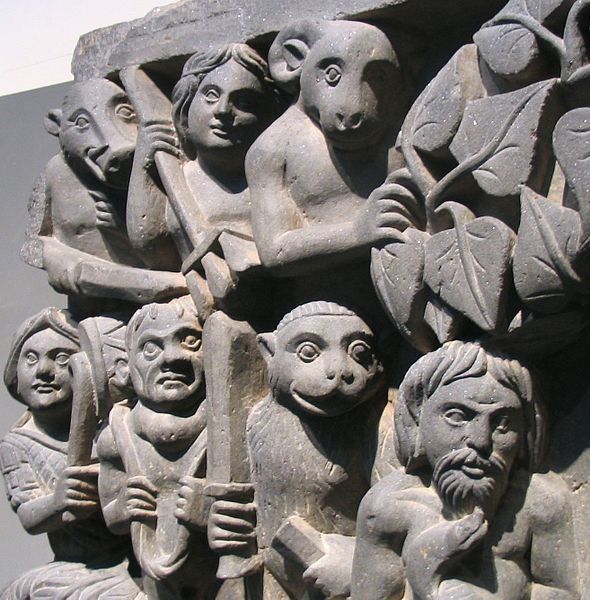
Next we saw examples of Buddhist art.  Our docent explained that up until the first century CE artists did NOT depict the Buddha.  Then, at that time, they began to depict him.  Here are outside links to a frieze depicting the Buddha's life:

http://www.arthist.umn.edu/aict/html/non_west/IND/IND009.html

http://upload.wikimedia.org/wikipedia/commons/thumb/e/ed/Four_Scenes_from_the_Life_of_the_Buddha_1.jpg/590px-Four_Scenes_from_the_Life_of_the_Buddha_1.jpg

The frieze was carved in Afghanistan, which is not surprising as Buddhism quickly became an international religion.  However, our docent noted that the sculptors of the frieze may have been Greek or Persian as their style was more Greek.  He then pointed out a figure wearing armor that seemed more appropriate to the Iliad than to the life of the Buddha. 

Here is a link from Ohio State about another frieze from India.  This page is quite informative.

http://kaladarshan.arts.ohio-state.edu/studypages/internal/dl/SouthAsia/Buddhist/pgs/u5/DL0209m.htm

We also looked at examples of Hindu art.  Unfortunately, we did not see any figures of Ganesh!  But here is an especially striking bronze of the god Shiva.  It is from the tenth century CE:

http://www.asia.si.edu/collections/singleObject.cfm?ObjectId=38637

This statue is a bronze of a devout queen as the goddess Parvati.  Our docent noted that a statue in a temple usually would have been garlanded and even clothed.
http://www.asia.si.edu/collections/singleObject.cfm?ObjectId=9849

Finally, here is a later statue of a child saint:

http://www.asia.si.edu/collections/singleObject.cfm?ObjectId=11802

We also saw some Japanese screens.  These were not on display, but the Freer owns some that depict scenes from The Tale of Genji:

http://www.asia.si.edu/collections/singleObject.cfm?ObjectId=39454


http://www.asia.si.edu/collections/singleObject.cfm?ObjectId=46858


http://www.asia.si.edu/collections/singleObject.cfm?ObjectId=46859

Below is a nineteenth-century scroll also depicting a scene from the novel:

http://www.asia.si.edu/collections/singleObject.cfm?ObjectId=28475


The Freer Gallery also contains the Peacock Room, which was designed by the influential artist James McNeill Whistler.  Did you know that he attended West Point for a year or so?

http://www.asia.si.edu/collections/singleObject.cfm?ObjectId=2122


Below are some of Whistler's works that we saw.  Note that they show the influence of Japanese art:

http://www.asia.si.edu/collections/singleObject.cfm?ObjectId=1924


http://www.asia.si.edu/collections/singleObject.cfm?ObjectId=151

To compare, here is a link to an 1859 work by American painter Frederic Edwin Church:

http://commons.wikimedia.org/wiki/Image:Church_Heart_of_the_Andes.jpg

This painting by Winslow Homer is from 1876, around the time that Whistler was working on "The Balcony" (see above):

http://commons.wikimedia.org/wiki/Image:Winslow_Homer_003.jpg

We concluded with a visit to an exhibit of Chinese paintings with literary themes:

http://www.asia.si.edu/exhibitions/current/talescont.htm

Hope you enjoyed this entry on our visit to the Freer Gallery!

Wednesday, March 26, 2008

The Love Suicides at Amijima

I should be grading my papers from EN 101A, and in class we are moving on beyond drama to...film, but I thought that I would post a quick blog entry on the play that we have just read, The Love Suicides at Amijima.  The picture above is from a 1997 English-language version performed at NYC's LaMama Theater.  For more information about this production, see this link below:
http://www.theatrejapan.com/amijima.html

A professor at Washburn University in Kansas has posted background on the play. 

http://www.washburn.edu/reference/bridge24/Chickamatsu.html

For more information about bunraku (the genre that this play originally belonged to):

http://www.japan-zone.com/culture/bunraku.shtml

http://www.sagecraft.com/puppetry/definitions/Bunraku.hist.html

http://www.puppetcentre.org.uk/animationsonline/aotwentyone/ao21_whatsinaname.html

Here are video clips of bunraku although not of Love Suicides:

http://www2.ntj.jac.go.jp/unesco/bunraku/en/video.html

In 1969, a film version of Love Suicides (Double Suicide) appeared:

http://www.gotterdammerung.org/film/shinoda-masahiro/double-suicide.html


Wednesday, March 19, 2008

Scenes from Mother Courage By Brecht

I thought that I would put together an entry linking to various videos of Mother Courage.  They will have to do until someone decides to film this play or I decide to spring for a DVD from Germany.  First, though, here is a review of the production pictured above:

http://www.musicomh.com/theatre/mother-courage_1106.htm


Here is a quick scene from an Illinois' high school's production:

http://www.youtube.com/watch?v=1S5XZgV2Hd0

This production is by "Theater Bayside":

http://www.youtube.com/watch?v=e4Y-icyZFZg

This video of "The Death of Kattrin" is short, but the scenery looks more professional:

http://www.youtube.com/watch?v=mwa_Z2iQP00


Villanova University's Theater Department has a slide show of its production of Mother Courage and a video of the set and costume designers at work:

http://villanovatheatretalk.blogspot.com/2007_10_01_archive.html


I am desperate, so I am going to add some reviews with extensive pictures and/or description!

See this links for pictures from Rutgers-NJIT's production:

http://theatre.njit.edu/pictures.php?d=mothercourage&n=MOTHER%20COURAGE%20AND%20HER%20CHILDREN


Minneapolis'  Frank Theater has done Mother Courage recently.  For once, the play is reviewed glowingly!  See the second link for an interview with Wendy Knox, the founder of this theater:

 http://www.talkinbroadway.com/regional/minn/minn171.html

http://minnesota.publicradio.org/display/web/2006/10/20/wendyknox/

In 2003, a theater company in the UK put on a production with disabled actors:

http://www.culturewars.org.uk/2003-02/mothercourage.htm

A year later, The Eclipse Theater Company toured the UK with its version of Mother Courage translated by Afro-British playwright Oladipo Agboluaje.  In this version, Mother Courage is set in modern-day West Africa.  For more details, see these links:

http://www.eclipsetheatre.org.uk/mcahc.htm


http://www.bbc.co.uk/northamptonshire/stage/2004/mother_courage.shtml


http://www.bbc.co.uk/suffolk/going_out/on_stage/2004/03/mother_courage/preview.shtml

http://www.theatrevoice.com/listen_now/player/?audioID=483


These reviews from Pittsburgh and San Diego may explain why I am desperate!

http://www.pittsburghcitypaper.ws/gyrobase/Content?oid=oid%3A24565

http://www.sandiego.com/option,com_sdca/target,9e394025-6005-4bb4-b426-15f018d60a0d/